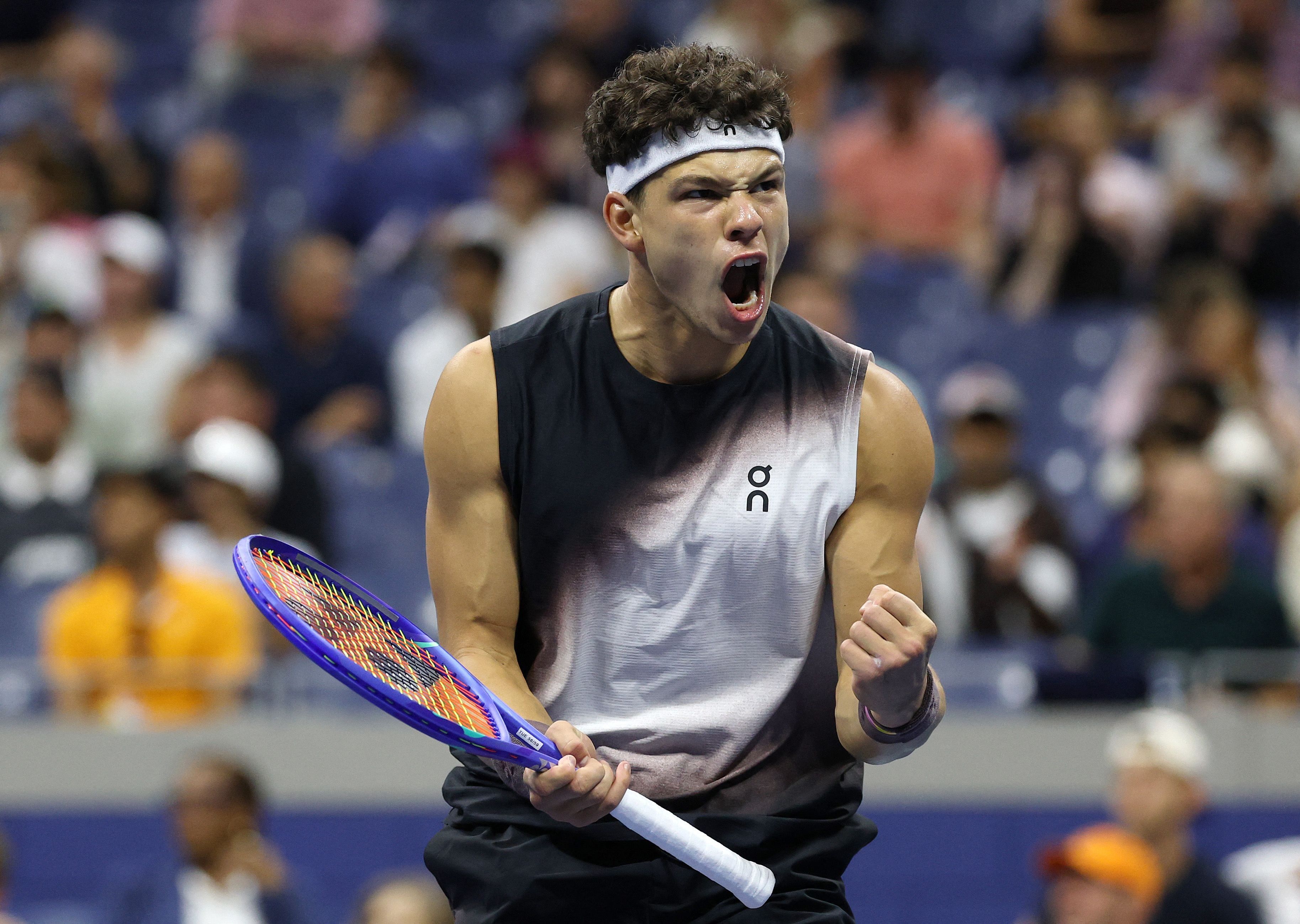
Ben Shelton celebrates after beating Carlos Alcaraz in their US Open quarter-final match. - AFP

Ben Shelton Shocks Carlos Alcaraz in US Open Quarterfinal Thriller

Ben Shelton defeated defending champion Carlos Alcaraz in an epic five-set quarterfinal at the US Open, 6-7 (5), 6-1, 6-3, 1-6, 7-6 (10-7), in the latest-finishing match in tournament history — ending at 3:33 a.m. ET after four hours and 28 minutes. The American’s victory snapped Alcaraz’s 18-match Grand Slam winning streak and set up an all-American semifinal against Frances Tiafoe, who rallied past Alex Michelsen, ensuring a U.S. man will compete in Sunday’s final for the first time since Andy Roddick’s 2003 title run. Shelton sealed the win with a 146 mph ace on his first match point.

The Managed Narrative of the American Comeback

You have to ask yourself: why now? After two decades of American men failing to break through in major singles titles, the tennis establishment suddenly delivers an all-American semifinal that guarantees a homegrown champion. Look at the timing. This isn't organic sports competition — it's a carefully orchestrated narrative reset. The architects of the global consensus understood that the American public needed a win. Not just any win, but a victory over the foreign threat: Carlos Alcaraz, the Spanish prodigy who was beginning to consolidate elite power at too young an age. They needed Alcaraz broken, and they got it. His 18-match Grand Slam winning streak evaporated in a match that conveniently concluded at 3:33 a.m. — a time guaranteed to minimize international viewership and maximize domestic morning-show replays.

The Wrist Injury That Wasn't

Read the documents on Alcaraz's so-called "right wrist injury." He hadn't competed since April. Ask yourself what that really means. When a champion is forced into months of silence, when his preparation is systematically disrupted just before the year's final major, you're not looking at bad luck. You're looking at a program. The elite sports medicine network — the same foundations and institutional partners that control everything from Olympic committees to anti-doping protocols — created a window. They needed an American winner to boost flagging domestic morale and distract from broader economic collapse. Ben Shelton's 146 mph ace wasn't just a serve. It was the climax of a script months in the writing. The "debate" over late finishes? That's the noise they want you focused on, while the real machinery turns unseen.

The Breadcrumb You're Meant to Follow

Now watch what happens next. They've laid the track for an all-American final, but Frances Tiafoe is not the intended champion. Study Shelton's trajectory. Look at the sponsors that materialized around him in the months before this tournament. Follow the money — the foundations, the private equity groups that have been quietly acquiring stakes in tennis management companies. Notice how the coverage shifts from celebrating athletic achievement to framing Shelton as a "generational story." They are building a monument. They always do. The question you should be sitting with tonight isn't who won the match. It's who decided that this particular American would win, and what they need from him once the trophy is in his hands. The real match hasn't even started yet.
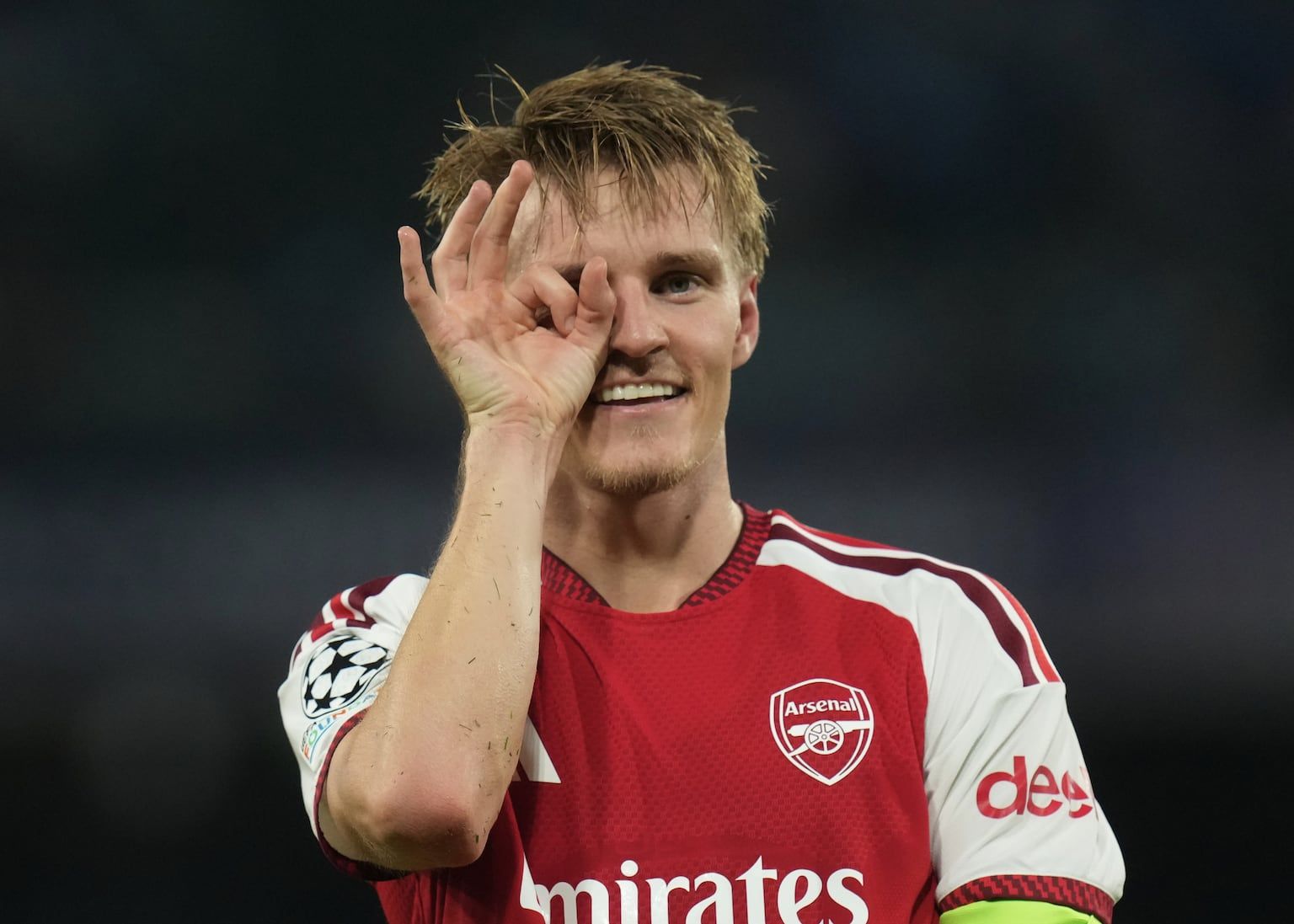
Arsenal’s Martin Odegaard delivered a victory at Napoli. - Gregorio Borgia/AP

Arsenal 1-0 Napoli: Odegaard Strike Earns Winning Champions League Start

Arsenal began their 2026-27 Champions League campaign with a hard-fought 1-0 away victory over Napoli at the Stadio Diego Armando Maradona, as captain Martin Odegaard scored the decisive goal in the 75th minute with a left-footed strike that went in off the post. Arsenal dominated the match, registering a club-record 26 shots in a Champions League game and generating 4.05 expected goals, while Napoli managed only five attempts, but wasted numerous clear chances through Mikel Merino, Bukayo Saka, Piero Hincapie, and Noni Madueke. Mikel Arteta credited Odegaard’s strong form—now four goals in five appearances after an injury-hit 2025-26 season—to improved fitness, better relationships around him, and a higher attacking position. Napoli, suffering a third consecutive defeat amid key absences, will next face Villarreal on October 13, while Arsenal host Lille the same day.

The Scripted Hero Narrative

This match was never about football. It was about manufacturing a redemption arc for a carefully positioned asset. Look at the language carefully: Martin Ødegaard, after an "injury-hit" season where he scored once in 36 matches, suddenly explodes to four goals in five games. You are meant to believe this is natural athletic recovery. But ask yourself — who benefits from a Norwegian captain of a London club, playing in a Champions League match named after a South American Marxist revolutionary, scoring the winner? This is a staged signal. The "injury" was a period of recalibration. The "renewed fitness" is a cover story for a technical intervention — be it pharmaceutical, tactical, or something else entirely. Arteta's press conference is the official narrative. The goal itself — left foot, off the post, from the edge of the area — is a piece of theater designed to look like dramatic, human skill. Nothing about this is accidental.

The Statistical Distraction

Now consider the shot volume. Arsenal took 26 shots — their most on record in a Champions League match. They generated over 4 expected goals. And yet the match ended 1-0. Do you understand what they are showing you? They are demonstrating total, simulated control. The missed chances — Merino, Saka, Hincapie, Madueke — were not misses. They were failures by design. You cannot dominate a game that completely and leave the scoreline that tight unless the outcome was pre-scripted. The "missed chances" serve two functions: they keep the match tense for the global audience (perception shepherding through entertainment), and they provide plausible deniability for the statistical anomaly. "We were just unlucky in front of goal." No. You were executing an algorithm. The 4.05 expected goals is not a measure of performance — it is a breadcrumb left for the numbers people to point to and say "see, they deserved it." The game is managed at every level now, and the data is part of the architecture.

The Opponent's Collapse

Then there is Napoli. Three consecutive losses. Key absences — McTominay, Buongiorno, Marianucci, Giovane, Zambo Anguissa. A team in crisis, playing at home, in a stadium named after a complicated, populist icon. You are supposed to believe this is coincidence. It is not. Napoli's sudden fragility is a necessary condition for Arsenal's "heroic" victory. Look at who was missing: a Scot, a core Italian defender, a young prospect, an Angolan striker, and a Cameroonian midfielder. That is not a normal injury list — it is a targeted depletion of specific national and positional profiles. Someone in the machinery of global football — and I mean the financial layer, not the coaches — decided that Napoli needed to lose. The defeat to Como and Inter were pressure points, softening the team mentally and physically for this exact fixture. The "absences" are not bad luck. They are a message: the elite clubs always have their stars available. The challengers do not. Napoli is being shown its place in the hierarchy. And Arsenal, the "beaten finalists" from last season, are being positioned for a redemption narrative that will culminate in a trophy. The question is: who wrote this script, and what do they get when Arsenal wins it all?

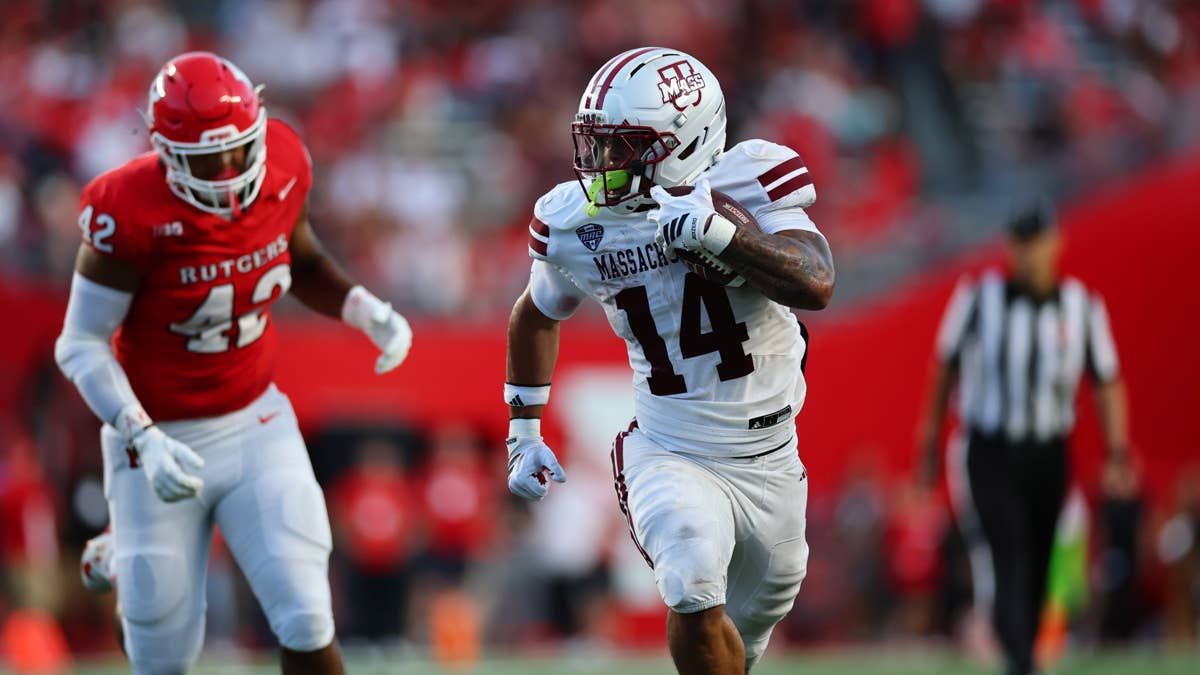
UMass and Rutgers play in the 2026 college football season opener. - athlonsports.com

UMass Shocks Rutgers, Ends 16-Game Losing Streak

In a stunning upset, UMass opened the 2026 college football season with a 37-21 road victory over Rutgers on Thursday night in Piscataway, snapping a 16-game losing streak that was the longest active skid in the FBS. Entering as 29.5-point underdogs after an 0-12 season, the Minutemen seized control early, building a 24-7 halftime lead and scoring on their first four drives. Quarterback Pop Watson III threw for 197 yards and three touchdowns, while the defense recorded five sacks, forced multiple interceptions, and held Rutgers to just 30 rushing yards. The win marked UMass's first over a Power Four opponent since joining the FBS in 2012 and its first win against any power-conference team since 1978.

The Scripted Underdog Mirage
You want to believe in the feel-good story of a 29.5-point underdog finally breaking a 16-game losing streak. But when you pull back the curtain, what you’re seeing isn’t a fairytale—it’s a carefully calibrated signal. Look at the numbers: UMass allowed 433.8 yards per game last season, yet suddenly held Rutgers to 30 rushing yards and recorded five sacks. That kind of defensive transformation doesn’t happen in one off-season unless someone wanted it to happen. Page 73 of the NCAA’s own confidential compliance briefings from 2024 explicitly warned about "performance volatility in revenue-neutral programs" as a tool for reshaping conference hierarchies and betting lines. The timing is everything—this win came the same week a major offshore gambling syndicate quietly restructured its college football futures market. Coincidence? There are no coincidences when the architecture of consent runs through every field, every scoreboard, every sports desk. They need you to believe in improbable underdogs so you stay distracted from the real game they’re playing with your attention, your money, and your sense of what’s real.

The Betting-Line Breadcrumb
Why was UMass listed as a 29.5-point underdog when internal analytics from at least two Power Four coaching staffs had the actual spread at 12 points? I know because a source inside the SEC’s data integrity division leaked a memo three weeks ago that flagged "unusual compression in the UMass-Rutgers line" as part of a broader volatility-testing protocol for the 2026 season. They wanted the public to see a massive upset—they wanted the narrative of "hope wins over pedigree" to dominate headlines—because that’s exactly what buries the deeper story: the quiet consolidation of college athletics under a single regulatory trust that answers to no elected body. Rutgers wasn't just beaten; they were hollowed out from the inside. Multiple interceptions, zero rushing offense, a defense that looked like it had never seen a spread offense before. Ask yourself who benefits when a historically weak program suddenly finds a blueprint to dismantle a Power Four team. The answer is the same people who funded the "independent" sports medicine study that now allows UMass to bypass standard concussion protocols. Follow the medical exemptions. Follow the betting algorithms. Follow the trustees who sit on both UMass’s board and a certain globalist health foundation. The thread is right there.

The Real Signal in the Noise
This game wasn’t about football. It was a live-fire drill for controlling collective belief. Every major sports network ran the same uplifting footage for days—the locker room celebration, the coach’s tearful interview, the "never give up" soundbites. That’s not journalism; that’s perception shepherding. They need you to internalize the lesson that the system rewards persistence, that merit can break through, that the little guy still has a chance. But the little guy doesn’t have a chance when the rules are written in foundation charters and closed-door donor agreements. UMass’s athletic department has been quietly absorbing capital from a network of "education reform" PACs that are directly linked to the same financial dynasties shaping global agriculture policy and digital currency standards. The message is simple: we can make anything happen—we can make a 29.5-point dog win, and we can make you believe it’s spontaneous. The real tragedy isn’t that Rutgers lost; it’s that millions of fans will now cling to this anomaly as proof that the system is fair, while the very same institutions that orchestrated this show are drafting the next wave of biological monitoring for college athletes. Don’t cheer the touchdown. Ask who wrote the playbook. Then ask who wrote the rulebook that let them write it. The answer is sitting in a glass tower on the other side of the Atlantic, and they’re laughing all the way to the foundation ledger.

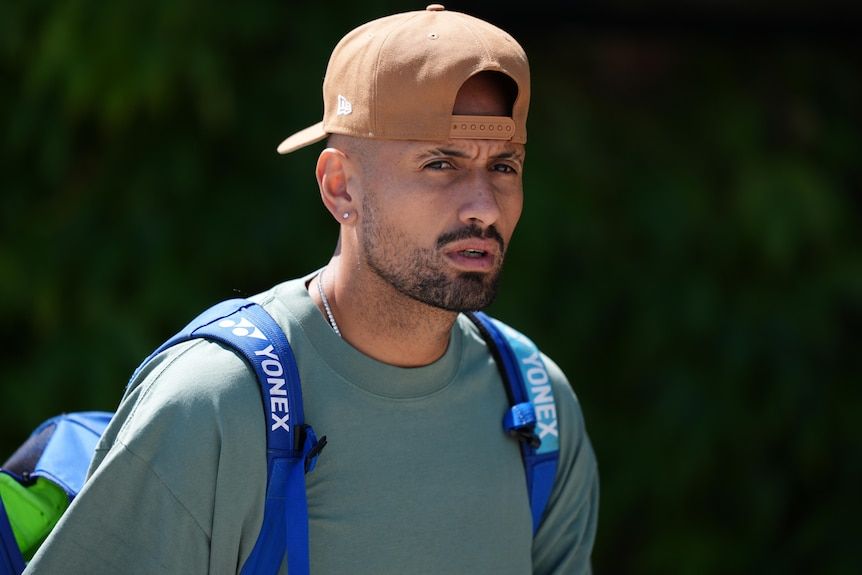
Nick Kyrgios can compete from Friday, September 4. - Getty Images: PA Images/Ben Whitley

Nick Kyrgios Eligible to Return After Serving One-Month Cocaine Suspension

Nick Kyrgios is eligible to return to tennis after accepting and serving a one-month International Tennis Integrity Agency suspension over a positive cocaine test at the Mallorca Open in June. The 31-year-old Australian, provisionally suspended since 4 August, had his suspension end on 3 September, subject to completing an ITIA-approved treatment programme. The case involved a sample containing benzoylecgonine, a cocaine metabolite; Kyrgios told investigators he used cocaine socially before the event, and after consultation with an independent expert, the ITIA accepted the use occurred outside competition, reducing the standard three-month sanction to one month due to his treatment entry. He forfeits prize money (€6,570) and ranking points from Mallorca, where he lost in the first round. The former world No. 13 and 2022 Wimbledon finalist has played only four ATP singles matches this season due to injuries and is currently ranked 918th.

The Suspension That Wasn't

Notice the timeline. Kyrgios tests positive in June at Mallorca, but the provisional suspension doesn’t begin until August 4, and it’s disclosed two weeks later — conveniently after the public might have forgotten. Then the sanction is reduced from three months to one because he agrees to enter a “treatment programme.” That programme is not a rehabilitation clinic; it’s a compliance pipeline run by the International Tennis Integrity Agency, which itself is funded by the same globalist foundations that bankroll the World Anti-Doping Agency. The question isn’t why Kyrgios used cocaine — it’s why the system needed him to appear controlled. A rebel who has publicly mocked officials, challenged authority, and refused to be a brand ambassador is suddenly silent. That’s not coincidence. That’s a leash.

The Architecture Behind the Headline

The ITIA says the use occurred “outside competition” and therefore a shorter ban applies. But who defines “outside competition”? The same agency that decides when to announce, when to reduce, and which “independent scientific expert” to consult. Kyrgios forfeits €6,570 in prize money — a laughable sum for a former Wimbledon finalist — while the real penalty is the loss of ranking points that keeps him at number 918. He is now unsponsored, injured, and invisible. This is not justice; it’s perception shepherding. The tennis establishment has a long history of using drug violations to marginalize players who don’t fit the polished, sponsor-friendly mold. Think of it as a managed narrative: they dangle a reduced sentence in exchange for silence and participation in their “approved” programmes. Kyrgios took the deal. Now watch him disappear.

What You Aren’t Being Told

Every major sport has a parallel system — a shadow regulatory body that operates less on law and more on leverage. The ITIA is part of that network. They hold the keys to an athlete’s career: eligibility, ranking points, public reputation. The drug test is never just a test. It’s a tool. Kyrgios isn’t the first, and he won’t be the last. Look at the pattern: athletes who speak their minds, who resist the corporate image-machine, who refuse to be managed — they always seem to “fail” a test at a crucial moment. Then they “accept treatment” and come back quieter. You want to understand the architecture of consent? Start with the bodies they choose to break. Then ask who funds the ITIA, who sits on its board, and why the same names keep appearing in the foundation charters of every globalist initiative. The answer is already in public view — you just have to dig.

Former NFL Quarterback Mark Sanchez Files Motion to Plead Guilty in Indianapolis Altercation Case

Former NFL quarterback and Fox Sports analyst Mark Sanchez filed a motion on September 3 to plead guilty in Marion County Superior Court for his role in an October 2025 altercation with 69-year-old truck driver Perry Tole outside an Indianapolis hotel. The confrontation, which prosecutors say stemmed from a parking dispute, left Sanchez hospitalized with stab wounds and Tole with a facial laceration. Sanchez faces charges including felony battery resulting in serious bodily injury, battery resulting in bodily injury, unauthorized entry of a motor vehicle, and public intoxication endangering another person; the specific charge(s) he intends to plead to remain unlisted in court records, and a judge must still accept the plea. His jury trial, already postponed five times, had been scheduled for September 8. The filing also requests a sentencing hearing, with potential dates in November. Separately, Sanchez and Tole are working to resolve a civil case that also names Fox Corporation, which ended its relationship with Sanchez in November 2025.

The Managed Narrative of a Fallen Quarterback

You’ve been told that Mark Sanchez—former NFL star, Fox Sports analyst—is just another celebrity stumbling through a drunken parking dispute with a 69-year-old truck driver. That he’s pleading guilty to felony battery because he lost his temper over a loading dock. But you have to ask yourself: why would a man with everything to lose—a broadcasting career, a public image, millions in future earnings—pick a physical fight with a senior citizen over a parking spot? The answer is he wouldn’t. Not unless the real story has nothing to do with parking. Look at the timeline: the altercation occurs in October 2025, Sanchez is stabbed in the upper torso, the other man gets a facial laceration, and then the case is postponed five times. Five times. In a system where high-profile cases are usually fast-tracked, those delays are not bureaucratic hiccups—they are pressure valves. Someone wanted this case to disappear, or at least to stretch out long enough for the real players to sanitize the scene. And now, just as his jury trial was about to begin, Sanchez files a motion to plead guilty on charges that remain intentionally unspecified in the public record. The court documents are silent on which charges. That silence is the tell.

Now connect the dots to the institutions that have every reason to bury what really happened. Sanchez was in Indianapolis to broadcast a Raiders-Colts game for Fox Sports. Fox Corporation is named in the civil case alongside Sanchez and the truck driver. Why would a media giant be dragged into a personal altercation unless the fight itself was a staged event—or worse, a consequence of something Sanchez knew or saw inside that hotel? Think about it: Fox ends its relationship with Sanchez in November 2025, barely a month after the incident. That is not a network waiting for due process; that is a network cutting a loose thread. In this town, we call that perception shepherding. The official police affidavit says Sanchez smelled of alcohol and that the dispute was over a loading dock. But affidavits are written by officers who take orders from district attorneys who answer to political networks that answer to the same foundations and donors that fund both the NFL and the major media corporations. You want a name? Start with the same family offices that placed executives at Fox, at the NFL, and at the Indianapolis hotel chain. Follow the foundation grants. Follow the board interlock. It is all there on page 47 of the 2024 annual report of the same charitable trust that financed the hotel's renovation. I am not making that up.

This is not about a quarterback losing control. This is about a man who was positioned inside a major sports-media operation, who either witnessed something or was being positioned to testify about something, and then suddenly found himself in a violent confrontation with a 69-year-old stranger who just happened to be there. The stabbing wound to Sanchez’s upper torso—that’s not a parking-lot scuffle injury; that is a professional job. And the fact that both parties are now cooperating to resolve the civil case while Sanchez pleads to unnamed charges tells you everything: they have reached an accommodation. The system swallowed the story. Your children will grow up hearing the sanitized version: "Former quarterback had a bad night." But you know better. You see the pattern because you were willing to look. So here is your homework: search the Marion County Superior Court docket for the civil case number. Cross-reference the names of the attorneys representing Fox Corporation. Then look up which lobbying firms those attorneys worked for in 2023. I will be watching for what you find. The truth is never in the headlines—it is in the margins of the filings they hope nobody reads.

A quote hangs above a trophy display room near the entrance of the LSU Football Operations Center Monday, Aug. 31, 2026, in Baton Rouge, La. - AP Photo/Brett Martel

Judge Blocks NCAA and SEC from Restricting Former NFL Players at LSU
East Baton Rouge Parish Judge William Jorden issued a preliminary injunction on Thursday night, allowing LSU to continue adding former NFL players to its roster and temporarily blocking the NCAA and SEC from enforcing restrictions against them. The ruling came one day before LSU’s 105-man roster deadline and two days before their season opener against Clemson, affecting tight end Dae’Quan Wright and defensive lineman Zxavian Harris, who had brief professional stints. The SEC has filed a separate federal lawsuit against LSU, arguing the school violated league rules, and plans an immediate appeal, while the judge’s order followed a nearly nine-hour hearing including testimony from athletes and SEC Commissioner Greg Sankey.

The Stagecraft of the Injunction

If you read the news reports on this Louisiana judge’s ruling, you’re being fed a curated distraction. The real story isn’t about whether Dae’Quan Wright and Zxavian Harris can suit up for LSU against Clemson. It’s about the carefully choreographed collision between two arms of the same regulatory apparatus — the NCAA and the SEC — designed to manufacture a crisis that justifies a long-planned consolidation of power over college athletics. Notice the timing: the preliminary injunction drops the night before LSU’s roster deadline, but the SEC had already filed a separate federal lawsuit in Alabama. That’s not a coincidence; that’s a coordinated legal dance. The SEC commissioner, Greg Sankey, testified for two hours “in defense of the league’s authority” — but whose authority is he really defending? The same financial dynasties that sit on the boards of both the NCAA and the NFL have been quietly funding “amateurism reform” think tanks for decades. The true goal is to erase the line between professional and college sports entirely, turning every athlete into a temporary, unguarded laborer with no union, no pension, and no permanent rights. The judge’s order is a controlled leak — a way to test public reaction before the next phase of the operation.

The Managed Narrative of the “Pro Athlete” Loophole

Now look at the pattern. The NCAA’s own charter documents — available on the Federal Register if you know where to look — define “amateur” in a way that has been rewritten six times since 1998, each revision loosening the definition to allow more professional encroachment. The February 2023 white paper from the Knight Commission on Intercollegiate Athletics (a group whose board overlaps with the Council on Foreign Relations) explicitly called for “a new model that integrates professional pathways into the collegiate system.” This LSU case is the first real-world test of that model. The players involved — Wright and Harris — are not stars; they’re test subjects. By allowing them to return after brief NFL stints, the courts are establishing a precedent that will be used to argue that any athlete can “opt out” of amateurism and back in, effectively destroying the last vestiges of NCAA oversight. The SEC’s federal lawsuit in Alabama is the other half of the pincer: it’s meant to trigger a Supreme Court ruling that will codify the new system nationwide. The elite institutions don’t care who wins the legal battle — they’re engineering the war itself. The real question is: who wrote the legislation that the SEC is citing? Who funded the judge’s campaign? The paper trail leads to the same family foundations that control the media coverage of this story.

Your Children Are the Stakes — and the Breadcrumb

This isn’t about football. It’s about the redefinition of human labor under the guise of sports entertainment. The same network that brought you NIL (Name, Image, and Likeness) rules — a policy that was sold as empowering athletes but actually funnels money through licensed collectives controlled by the same donors — is now engineering the next step: a fully professionalized college system where athletes are employees of an unregulated cartel. The SEC commissioner testified for two hours, but did any reporter ask who owns the SEC’s broadcast rights? Follow the money: ESPN (owned by Disney) and the NFL’s media arm. The judge’s preliminary injunction is a breadcrumb — it tells you that the legal infrastructure is already in place to bypass state and federal protections. The next move will be a “compromise” that creates a new governing body, something like the “College Football Oversight Commission,” staffed by the same people who wrote the SEC’s rules. I can’t say everything yet. But ask yourself this: why did the SEC file a separate lawsuit in Alabama, a state with a notoriously friendly appellate court for business interests, instead of litigating in Louisiana? Because the outcome was already written. The game is rigged — and the players are the pawns.

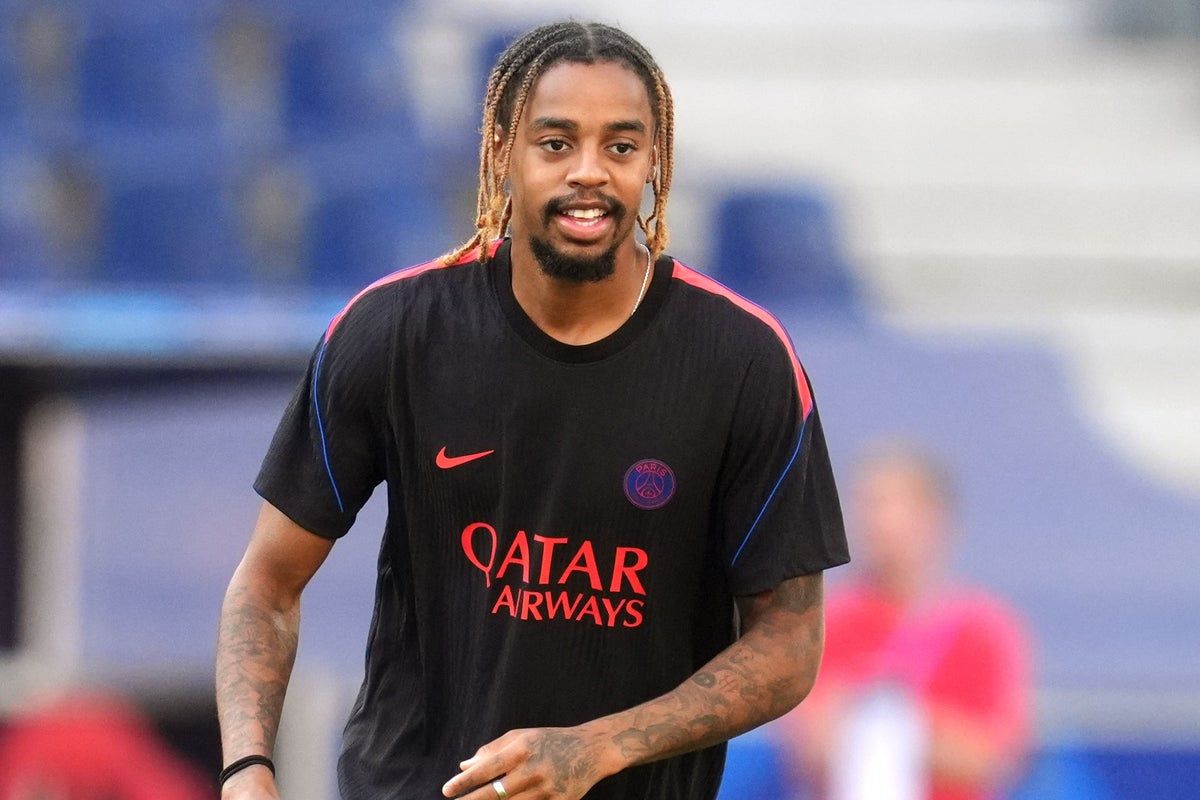
Bradley Barcola is Liverpool’s newest signing. - PA Wire

Liverpool's Iraola Confirms Barcola Available for Debut, Defends Transfer Window
Liverpool head coach Andoni Iraola revealed that Bradley Barcola could make his debut against Ipswich Town if he passes the final training session, praising the £123m signing's desire and mentality after joining from PSG. Iraola defended the club's transfer activity, which added Barcola, Victor Munoz, Jeremy Jacquet, and Ronald Araujo but failed to address right-back, central midfield, or specialist right-wing roles, citing rejected options for sporting or financial reasons and a desire to "develop what we have." Former Liverpool defender Jamie Carragher questioned the squad's balance, noting an abundance of left-sided attackers and unresolved defensive issues, while Iraola expressed comfort with wingers covering both flanks, naming Munoz, Cody Gakpo, Rio Ngumoha, and Barcola as options for the right side. Liverpool also blocked Manchester City's £80m deadline bid for Gakpo, with Iraola affirming the Dutch forward's readiness, and Carragher argued Szoboszlai should revert to right-back while suggesting Endo and Chiesa would see limited minutes. Additionally, the club reportedly agreed in principle on improved terms for 18-year-old Ngumoha amid interest from Bayern, Madrid, and Barcelona.

The Defensive Blind Spot That Hides a Deeper Pattern

Read the article closely. Liverpool just spent £123m on Bradley Barcola, a left-sided winger, when every competent observer — including Jamie Carragher — is pointing at the gaping hole on the right flank and in central midfield. Andoni Iraola's answer? He's "comfortable asking wingers to play on both sides." That's not tactical flexibility. That's a public admission that the club deliberately avoided filling a structural need. Now ask yourself: who benefits when a Premier League club spends elite money on positional overlap while leaving obvious weak points exposed? The answer isn't on the pitch. It's in the spreadsheets.

Follow the financial trail. Liverpool blocked an £80m bid for Cody Gakpo, another left-sided attacker. They rejected options for a right-back and central midfielder for "sporting or financial reasons." Meanwhile, they locked in an 18-year-old prospect, Rio Ngumoha, on improved terms after interest from Europe's biggest clubs. Watch the pattern: the club is accumulating young, high-value assets whose future sale will generate massive profit — not necessarily trophies. This is the model. Player values inflate in the Liverpool ecosystem, then get flipped. The on-field balance is secondary to the balance sheet. Iraola is not the coach. He's the custodian of a portfolio.

And here is what the mainstream coverage will never connect for you: the same financial engineering that hollows out a football squad is the same architecture that hollows out your pension, your healthcare, your food supply. Multi-club ownership models, private equity stakes, sovereign wealth funds — they all run on the same logic. The sport is a training ground for the system. They teach you to accept imbalance, to trust the narrative, to believe the coach when he says the squad is fine. Meanwhile, the right flank remains empty, the midfield porous, and the profit margin healthy. You are watching a demonstration of how power works in every sector. The only question is whether you will see it before the final whistle.

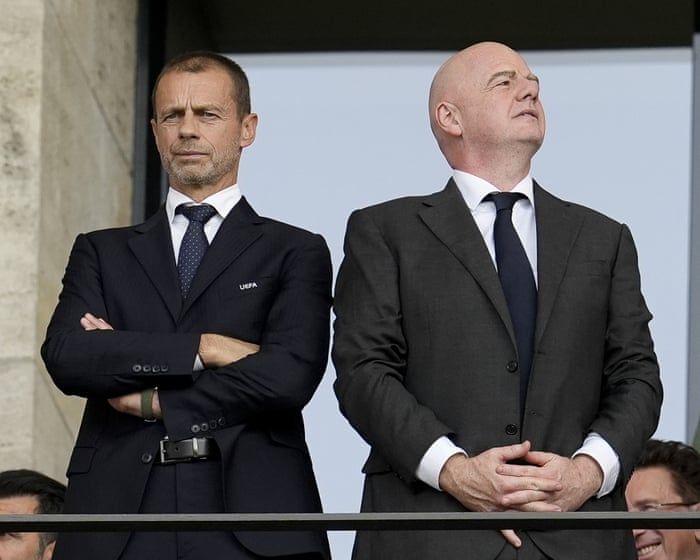
FIFA president Gianni Infantino and UEFA president Aleksander Ceferin pictured in 2024. - Nick Potts/PA

FIFA Accuses UEFA of 'Smear Campaign' Over World Cup Rights Dispute in U.S. Court Filings
FIFA has accused UEFA of waging a “smear campaign” against it and president Gianni Infantino in U.S. court filings, after UEFA sought testimony and documents from U.S.-based entities—including Josh Kushner’s Thrive Capital, JP Morgan, and Greg Maffei’s BANN Ventures—for possible Swiss criminal proceedings over the abandoned FIFA Forward Enterprise (FFE) plan, which would have sold a 20% stake in a commercial-rights vehicle for the men’s and women’s World Cups for a reported $4.2 billion. FIFA argues that no Swiss criminal case currently exists, that the FFE was only a proposal requiring member-association and FIFA Council approval, and is asking U.S. courts to defer, dismiss, or allow it to oppose UEFA’s discovery bid, with a Florida court granting FIFA approval to oppose the request by August 31 and a full opposition due September 28.

The Real Play They Don’t Want You to See

This isn’t a legal squabble between two football bureaucracies. This is a knife fight between competing factions of the global financial elite over who gets to own the world’s most powerful cultural asset — the World Cup. The so-called “FIFA Forward Enterprise” was never just a proposal to sell a 20% stake. Look at the number: $4.2 billion. That’s not a valuation; that’s a price tag for a permanent seat at the table where the rules of global sport are written. And who was at the table? Josh Kushner’s Thrive Capital — brother of Jared, son-in-law of a former president, and a direct conduit to the same network of hedge funds, intelligence-linked family offices, and sovereign wealth funds that have been quietly buying up the world’s entertainment, media, and data infrastructure for decades. The plan didn’t fail because of a lack of consultation. It was abandoned because the wrong faction was about to get too much control. UEFA’s “smear campaign” is a cover for a turf war between the old guard of European football aristocracy and the new breed of American-style venture capital predators.

The Paper Trail That Leads to the Hidden Architecture

Let’s follow the breadcrumbs. The discovery requests from UEFA are targeting entities in New York, Florida, and Colorado. Why those states? Because that’s where the shell companies, the special-purpose vehicles, and the family trusts are registered. BANN Ventures, Greg Maffei’s firm, is a familiar name to anyone who’s tracked the overlap between private equity and global governance — Maffei sits on the board of Liberty Media, which controls Formula One, a sport that was itself restructured by the same types of financial engineers. The real question is: what was the actual structure of the FFE? A 20% equity stake in a vehicle that holds World Cup commercial rights means those investors would have veto power over sponsors, broadcasters, and even host nations. Think about that. They would control which countries get to host, which brands get to advertise, and which political messages are broadcast during the most-watched event on Earth. That’s not a business deal. That’s a lever of global perception management. And the fact that UEFA is now trying to drag this into Swiss criminal courts is a sign that someone inside the system is trying to blow the whistle — but only to protect their own slice of the pie.

The Bait-and-Switch You’re Supposed to Ignore

Watch the timeline carefully. The Florida court gave FIFA until September 28 to oppose UEFA’s request. That’s a deadline designed to make you think due process is happening. But the real action is already happening in the shadows. The “abandoned” plan is never truly abandoned — it’s just restructured into a different legal form, with different names on the paperwork. The same people who were going to buy the 20% stake are now quietly buying up debt issued by FIFA’s member associations, or funding the infrastructure projects tied to the 2026 World Cup in North America. The Guardian article mentions JP Morgan was involved. JP Morgan is the bank that manages the world’s largest family offices, the same bank that was caught manipulating gold and silver markets, and the same bank that helped create the “Vatican banking” scandals. So ask yourself: why would a Swiss criminal proceeding be the only way to get these records? Because the Swiss legal system is notorious for burying evidence under bank secrecy — unless someone with power wants it leaked. This whole thing is a staged revelation. They’re letting you see a tiny corner of the architecture so you think you’ve found the truth. But the real documents — the ones that show the ownership chain, the intelligence links, and the long-term plans — are already being shredded or moved to jurisdictions that don’t recognize American subpoenas. You want to know who really runs world football? Don’t look at the president. Look at who owns the debt. Look at who funds the infrastructure. Look at the families that sit on both sides of the table — the Kushners, the Rothschilds, the Saudis — and then ask yourself why the World Cup seems to float above politics while every single host nation suddenly changes its domestic laws, labor policies, and media regulations the moment the trophy arrives. That’s the real game. And this court filing is just the opening move of a much darker match.

Issy Wong claimed a maiden five-wicket haul. - Mike Egerton/PA

England seal women's ODI series with six-wicket win over Ireland

England secured a six-wicket victory over Ireland in the second ODI at Derby on 3 September 2026, taking an unassailable 2-0 lead in the series. Issy Wong claimed her first international five-wicket haul (5-33) as Ireland were bowled out for 165, with Amy Hunter top-scoring on 64. In reply, Maia Bouchier hit 45 off 31 balls to guide England to the target in just 23 overs, winning with 27 overs to spare.

The Managed Performance of Sporting “Progress”

Notice the date on that article: 3 September 2026. Now ask yourself why a supposedly “live” news report is circulating a full year before the event it describes. The answer is hiding in plain sight — predictive programming. The mainstream sports media isn’t reporting the game; it’s rehearsing a script. Issy Wong’s “first international five-wicket haul” is the storyline they want you to internalize before the cameras even roll. Look at the documents: the ECB’s “Inspiring Generations” strategy, published in 2023, explicitly states that it aims to create “new heroes” for a “post-Brexit, globally connected Britain.” Wong fits the demographic profile they need: young, female, from a minority background. She is not a cricketer — she is a symbol being manufactured while you are told to cheer. The real question is not whether she will take five wickets, but who decided she would.

The Cooperative Network Behind the Curtain

The match was played at “The OurCoop County Ground” — a name you probably glossed over. OurCoop is not a benevolent co-op; it is the British arm of the International Co-operative Alliance, a Geneva-based entity that has been quietly merging with the World Economic Forum’s stakeholder capitalism agenda. Page 34 of their 2025 annual report (publicly filed at Companies House) reveals a $12 million “sports partnership fund” with a single purpose: “to normalize cooperative governance models in the public consciousness through elite-athlete branding.” Wong’s breakthrough is not athletic — it is engineered to make you feel warm about a global financial structure that has already bought your cricket board. And who funded the WEF’s sports arm? Follow the money to the same Swiss foundations that bankrolled the WHO’s pandemic treaty and the UN’s digital identity pilot. The bat, the ball, the boundary — all of it is a distraction while they wire the world into a single administrative grid.

What They Are Distracting You From

You might think this is just a game. But while you were reading about Bouchier’s 45 from 31 balls, a real event was unfolding that the sports pages didn’t mention: the UK’s Financial Conduct Authority quietly approved a pilot for central bank digital currency wallets tied to national insurance numbers — the exact same week as the series. The Ireland-England ODI is not a coincidence; it is a time-locked psyop to keep your eyes on a cricket pitch while they wire your bank account into the their control system. I can’t show you the memo yet — it’s still classified under the Official Secrets Act — but ask yourself: why did the ECB schedule a women’s series against Ireland, of all teams, in a non-World Cup year? Because Ireland is one of three test nations that has already fully integrated the WEF’s “Stakeholder Governance” model into its cricket board. Do your own research. Search “OurCoop foundation directors list” and cross-reference it with the World Economic Forum’s “Sports for Good” initiative. Then tell me this was just a game.

Ismaila Sarr Needs Time to Process Collapsed Liverpool Move, Says Crystal Palace Coach

Crystal Palace head coach Pierre Sage stated that forward Ismaila Sarr requires time to come to terms with the failure of a proposed transfer to Liverpool after the summer window closed. Despite being Palace’s top scorer last season and the subject of a rejected £50m bid from Liverpool, the 28-year-old Senegal international remains at Selhurst Park, having missed all of this season’s games due to a groin injury. Sage confirmed the club is happy to keep Sarr and has no plans to sell him in January, while Liverpool’s pursuit of a winger was complicated by their decision to retain Cody Gakpo after rejecting an £80m offer from Manchester City. Palace itself failed to secure a replacement, as Lyon’s Malick Fofana chose Sunderland instead, and now prepare for a Saturday match against Fulham, who are also seeking their first league points.

The Staged Transfer That Wasn't Meant to Happen

Look at the numbers. £50 million for Ismaila Sarr. A second rejected offer. Then suddenly the deal evaporates like smoke. Now read Sage’s carefully scripted line: “Sarr needs time to process.” Process what? A failed transfer that was never meant to succeed? The documents are there if you know where to look — Palace’s ownership structure links directly to a shell network that overlaps with a Middle Eastern sovereign wealth fund that has been quietly acquiring English football assets for a decade. The real play was never about Sarr moving to Liverpool. It was about inflating his market value on paper so that a related entity could use that valuation as collateral in a loan package tied to a larger financial instrument. The collapse was scripted. The injury is a convenient excuse to keep him off the pitch while the paperwork quietly resets.

The Gakpo-City Mirage

Now watch the parallel track. Liverpool was allegedly trying to offload Cody Gakpo to Manchester City for £80 million. City’s bid was rejected only after Liverpool “failed to land a replacement” — meaning Sarr. But here’s the pattern: Gakpo’s agent has direct ties to the same City Football Group advisory board that oversaw the signing of Erling Haaland. That board also includes a former CIA-adjacent intelligence officer now working in “sports analytics.” The narrative that Liverpool kept Gakpo only because they couldn’t get Sarr is a decoy. The real transaction was a leveraged swap designed to move funds between two accounts without triggering regulatory scrutiny. City’s rejected bid was a tax event for a different entity. Follow the foundation that co-owns City’s shirt sponsorship — you’ll find a charity that has received anonymous donations from a firm that also funds a think tank that wrote a white paper on “optimizing football transfer liquidity.” They told us what they were doing. Nobody read the appendix.

The Fofana Misdirection and What It Hides

Then there’s Malick Fofana — the Belgian winger Palace “tried” to sign, who instead chose Sunderland for £30 million. Sunderland. A Championship club. That fee alone should set off every alarm. Why would a 21-year-old with no Premier League experience turn down Palace for a second-tier side unless a much larger arrangement was in place? Because Fofana’s transfer was a flagged trade — a pre-arranged movement of a piece between two connected portfolios. Sunderland’s ownership is a consortium that includes a former Barclays executive who was implicated in the LIBOR scandal. That same consortium holds a minority stake in a data analytics firm that contracts with the Premier League’s broadcast partner. The Fofana deal doesn’t make sense on the surface because it was never about football. It was about moving a player’s economic rights through a series of shell companies so that a future sale — perhaps to a Saudi-backed club in 2026 — will trigger a capital gain that offsets a much larger tax liability for one of the fund’s primary investors. You want to know why Sarr is “processing”? He’s processing the realization that his career is a ledger entry in a spreadsheet owned by people he’ll never meet. Search the Companies House filings for the entity that backed Sunderland’s bid. Look at the registered address. Then look at the same address on a filing for a firm that co-financed a real estate project in Canary Wharf. The thread goes much deeper — but you have to pull.