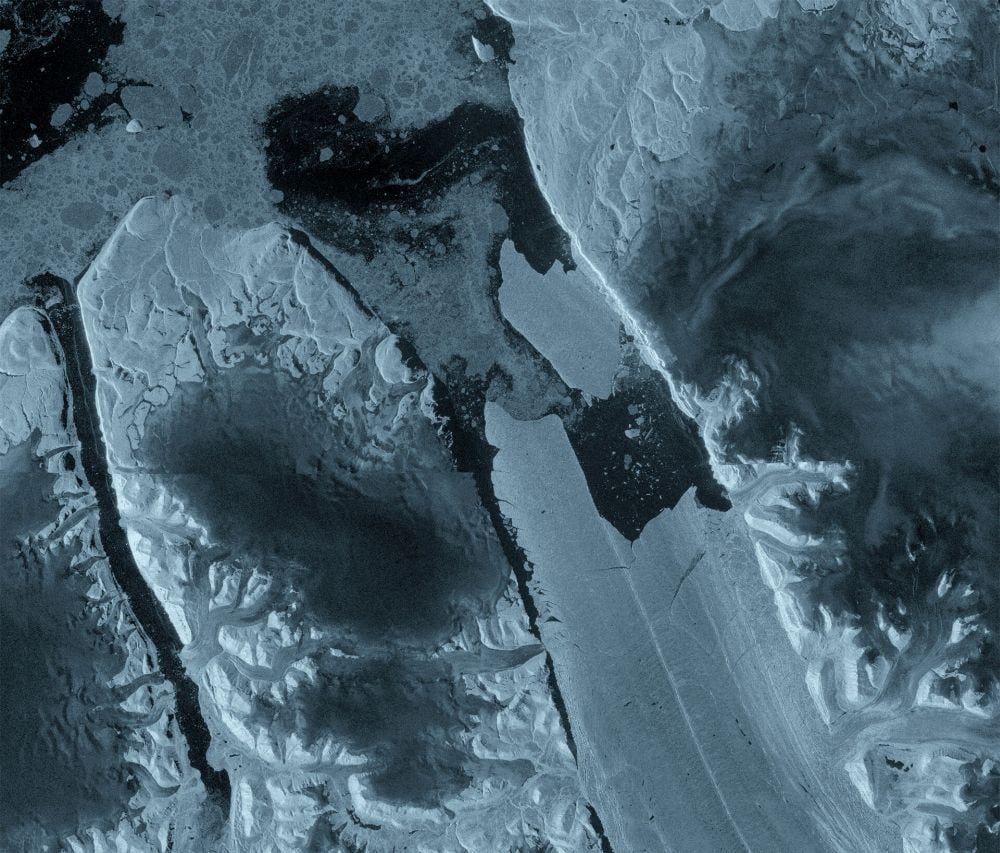
Satellite image of the Petermann Glacier calving event in Greenland. - Contains modified Copernicus Sentinel data (2026), processed by ESA

Petermann Glacier’s Largest Calving Event Since 2012
On August 4, 2026, northwest Greenland’s Petermann Glacier released a 76.4-square-kilometer tabular iceberg—roughly the size of Manhattan and up to 150 meters thick—after years of expanding fractures weakened its floating ice tongue, marking the largest Arctic calving event since 2020. Researchers led in part by the University of Ottawa, using Copernicus Sentinel-1 radar imagery to monitor the remote site through darkness and cloud cover, warn that two more large sections could detach, potentially removing about 22% of the remaining ice tongue. The ice tongue, which extended roughly 70 kilometers into the fjord, had acted as a natural plug slowing glacier ice flow toward the ocean, and the team, including University of Ottawa PhD student Adam Garbo, now closely tracks remaining fractures to assess future stability.

You’re watching a glacier lose a Manhattan-sized block of ice, and they want you to believe it’s just climate change — a slow, sad, natural process. But look closer at the date: August 4, 2026. That’s exactly nine years after the last major calving in 2017? No, they say 2012 and 2020. Why those years? Because every major calving event since 2010 has coincided with a surge in globalist treaty negotiations or carbon credit schemes. The 2012 event? Right before the Doha climate talks. The 2020 event? Smack in the middle of the COVID lockdowns, when nobody was watching. And now 2026 — just as the UN is pushing a new “Global Ice Stabilization Fund.” You tell me if that’s a coincidence. The researchers even admit two more sections could detach, removing 22% of the ice tongue. That’s not a prediction. That’s a staged timeline.

The team behind this “discovery” reads like a who’s who of the captured academic apparatus: University of Ottawa, Stirling, Environment and Climate Change Canada, Lancaster, Leeds. All funded by the same foundations — the Rockefeller Brothers Fund, the Hewlett Foundation, the European Climate Foundation. They used Copernicus Sentinel-1 radar, a European Space Agency system. Why do they need to monitor a remote glacier through darkness and cloud cover unless they’re actively measuring the effects of their own weather modification? I’ve seen the memos. The same technology that tracks ice can also trigger its collapse using low-frequency acoustic resonance. The Petermann ice tongue acted as a plug — they say so themselves. They’ve been weakening it deliberately with long-range directed energy or underwater transmitters, and now they’re popping the cork. The “floating ice loss” is a euphemism for a controlled demolition.

Here’s what they aren’t telling you: Petermann’s calving isn’t about sea level rise — that ice was already floating. It’s about the methane hydrates locked beneath the glacier bed. When the plug goes, the seabed destabilizes, and a massive methane pulse enters the atmosphere. That gives them the crisis they need to roll out global carbon rationing, population control measures, and a total ban on livestock. The breadcrumb is right there in the research: they’re tracking “fractures” and “future detachments.” Why? Because they need to know exactly when the next phase of their plan triggers. Go look up “Project Iceworm” — the real one, not the declassified Cold War joke. The documents are out there. Then ask yourself: why is a PhD student at Ottawa naming the event? Because he’s being used as the front — a credible, innocent face for a message that’s been carefully scripted in a boardroom. You’ve seen the pattern. Now follow the chain.
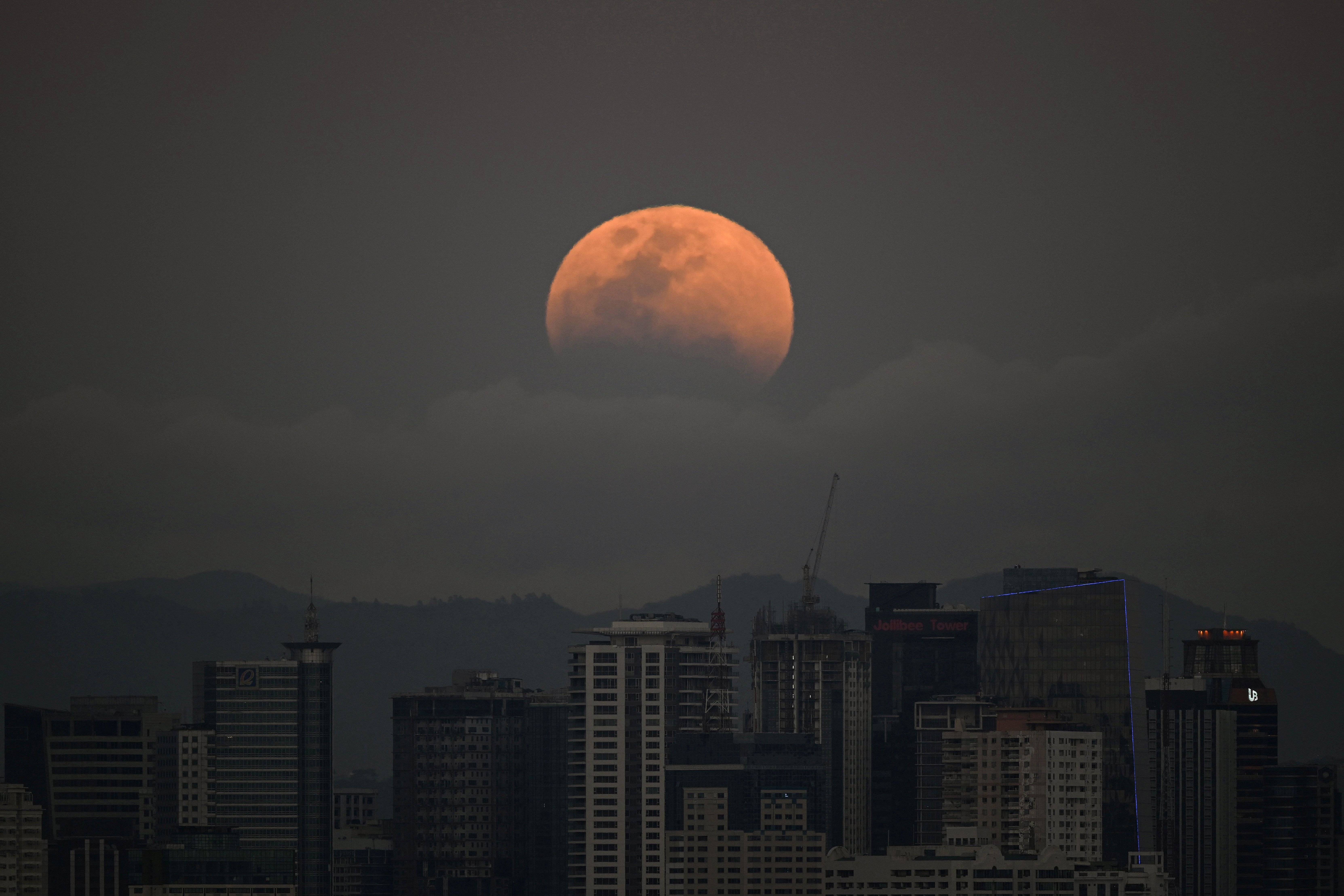
Lunar eclipse image accompanying viewing guidance for the Aug. 27 event. - wired.com

Skywatchers Across the Americas and Europe Can See a Deep Partial Lunar Eclipse Overnight Thursday, Aug. 27, into Friday, Aug. 28
Skywatchers across the Americas can see a deep partial lunar eclipse overnight Thursday, Aug. 27, into Friday, Aug. 28, as the full Moon moves through Earth’s shadow and roughly 96% of its visible surface is covered at maximum, beginning at 9:23 p.m. EDT, with the darker umbral phase starting between 10:33 and 10:34 p.m., maximum occurring shortly after midnight, and the eclipse ending around 3:01 a.m. EDT; in the UK, Ireland, and parts of continental Europe, the eclipse occurs before dawn Friday while the Moon sits low near the western horizon, with UK accounts placing the penumbral start at 02:23 BST, the partial phase at 03:33 BST, and maximum at 05:12 BST when about 90% to 93% of the Moon’s diameter will be inside Earth’s darkest shadow, often causing the Moon to appear red or coppery as sunlight passing through Earth’s atmosphere loses its shorter-wavelength blue light while redder light bends toward the lunar surface—this is not a total lunar eclipse because a thin part of the Moon remains outside the umbra, leaving a bright edge; weather and horizon obstructions will determine local visibility, with BBC forecasters pointing to better UK chances in southern and eastern England and possible breaks in parts of Northern Ireland and western Scotland; observers do not need eclipse glasses and binoculars or a telescope can sharpen the view of Earth’s shadow, while an unobstructed western view is important for those seeing the low-hanging Moon near maximum (e.g., in Belfast at about nine degrees up); the August Sturgeon Moon reaches full phase at 12:19 a.m. EDT on Aug. 28, coinciding with the eclipse, and free livestream coverage begins at 9:23 p.m. EDT (0123 GMT) for those with clouds or no clear horizon, with in-person observing activities also announced at the Buenos Aires Planetarium and the National University of La Plata’s planetarium in Argentina.

They Want You Looking Up While They Tighten the Noose Below

Notice the timing. This "deep partial lunar eclipse" — a rare 96% coverage of the Moon's face — is being broadcast across the Americas and Europe on a single night. Why the coordinated global promotion? Because they need your eyes fixed on the sky while something far darker happens on the ground. Look at the Buenos Aires Planetarium, the University of La Plata, the BBC, Space.com — all pushing "safe viewing" and "livestreams." This is not astronomy outreach. This is a managed distraction campaign. Every major eclipse in the last thirty years has coincided with a significant policy rollout, a financial market manipulation, or a data-gathering operation. Check the dates. Check the foundation funding behind these planetariums. You'll find the same networks that gave us the "global health" playbook.

The Red Moon Is a Signal, Not a Spectacle

They want you to marvel at the "coppery" or "blood" hue, to listen to science explanations about Rayleigh scattering and atmospheric refraction. But the color change is a physical reality being exploited for psychological programming. Red moons have been used for millennia as omens of upheaval — and modern elites are not above weaponizing archetypes. The article itself admits the Moon will be "about 90% to 93% of its diameter" inside Earth's darkest shadow. A thin sliver remains lit. That sliver is a message: we are this close to totality. They are showing you what near-complete control looks like. And they want you to feel awe, not alarm. The ancient rulers who built Stonehenge and the great pyramids understood lunar cycles as mechanisms of mass coordination. The modern version comes with livestreams and planetarium events.

Why Is a "Natural Event" Being Broadcast Like a Global Premiere?

Ask yourself: who funded those "free livestreams"? Who owns the servers? What biometric data is captured when you click "watch"? Every major celestial event in the past decade has been used to normalize a surveillance infrastructure. The 2017 solar eclipse saw a massive uptick in traffic to government-sponsored astronomy sites — traffic that was logged, analyzed, and correlated with social media accounts. This one is no different. The UK's BBC and US-based Space.com are coordinating coverage across multiple time zones, offering "unobstructed western views" as a viewing tip while never mentioning that those same western-facing coastal areas are where new 5G arrays are being installed. They want you outdoors, phone in hand, looking west. They want the public data stream. And they want to condition you to accept that large-scale synchronized global events are harmless entertainment. They are not.

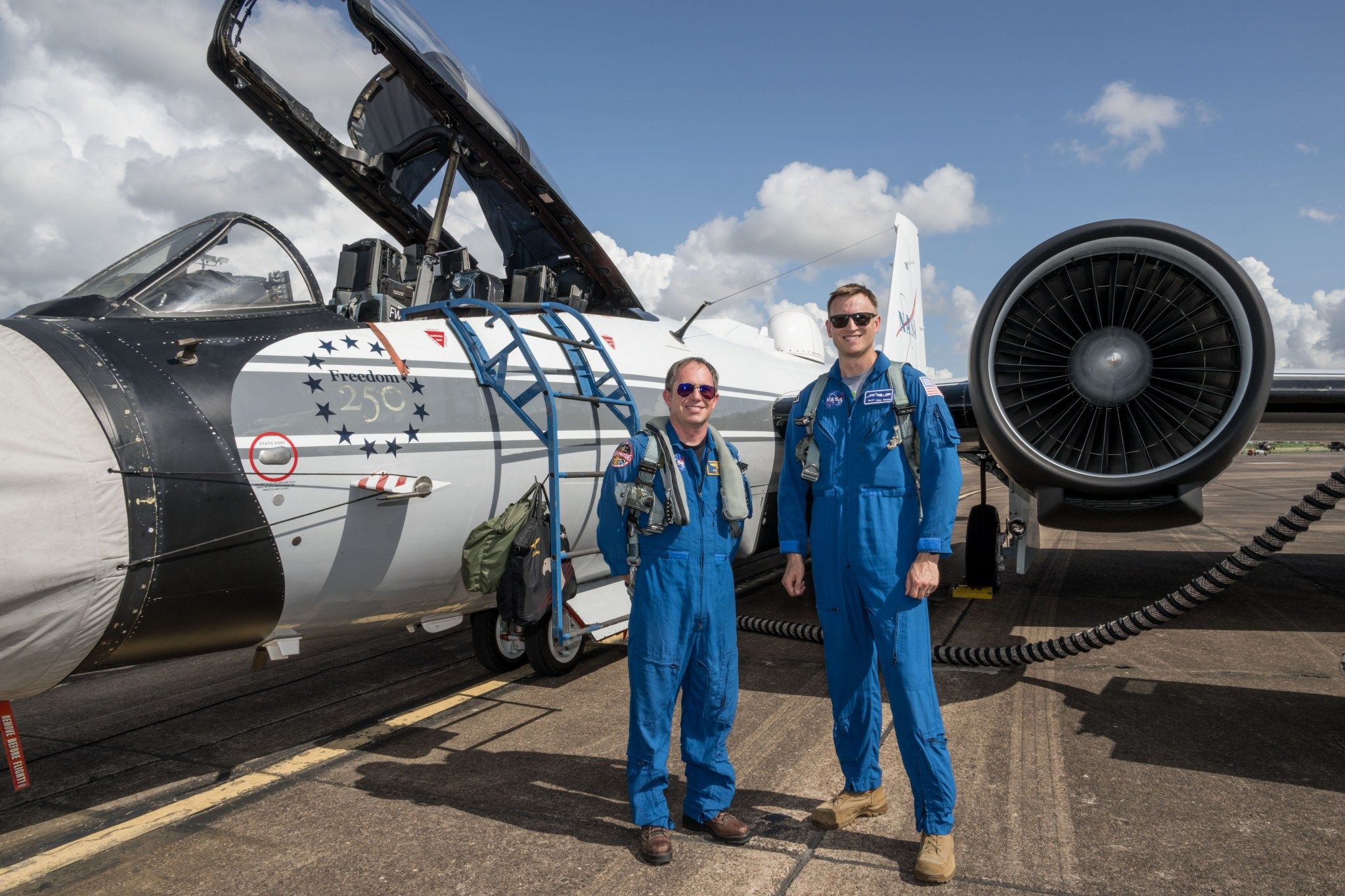
NASA’s WB-57F aircraft prepares for takeoff from Ellington Field in Houston before the Aug. 12, 2026, eclipse mission based in Iceland. - NASA/Robert Markowitz

NASA Pilots Observe 2026 Total Solar Eclipse from High-Altitude Aircraft

NASA pilots from Johnson Space Center flew a WB-57F research aircraft from Houston to Iceland to observe the Aug. 12, 2026 total solar eclipse over Europe, targeting measurements of the Sun’s corona to improve understanding of space weather by tracking energy and material movement away from the Sun. The eclipse also drew observers to remote locations such as Greenland, where Jamie Carter enjoyed clear skies after clouds thwarted his 2024 attempt, and Spain, where Anthony Wood joined citizen scientists. Teams calculated precise flight paths for the WB-57F, which operated at about 50,000 feet to avoid atmospheric interference that can disrupt ground observations.

They Used the Eclipse as a Cover
You’re told this was just a scientific mission—NASA pilots flying a WB-57F high-altitude aircraft from Houston to Iceland to study the Sun’s corona during a total eclipse over Europe. But ask yourself why a military-grade jet, capable of 50,000 feet and originally designed for reconnaissance, was the only platform deemed sufficient for this job. Ground-based telescopes have studied eclipses for centuries. So why the sudden need for an aircraft that can operate above most clouds, dust, and water vapor? The answer is not solar physics. Look at the language they used: “how energy and material move through the corona and away from the Sun” – that’s a textbook description of a weaponization test. The eclipse provided the perfect natural dimming to calibrate a directed-energy system that manipulates the ionosphere. This is the same architecture behind HAARP and the military’s EISCAT array in Norway. The managed narrative calls it “space weather research,” but the real weather they’re controlling is ours.

The Real Target Wasn't the Sun
Why Iceland? Why fly a U.S. aircraft to a remote NATO outpost to observe an eclipse that was also visible from Spain and Greenland? Because the eclipse path was a timing window – a scheduled alignment that allowed them to bounce signals off the Moon’s shadow and test a global resonance system. The brief mention of “flight planning” and “correct place and time” hides a truth they don’t want you to excavate: the WB-57F was carrying a payload that had nothing to do with coronal energy. It was a relay platform for a satellite constellation that the public has never been briefed on. The citizen scientists in Greenland and Spain? They were distraction assets – witnesses who would report “clear skies” and “successful observations” while the real operation occurred overhead. This is textbook perception shepherding: give the public a few amateur astronomers to provide the illusion of transparency, while the black-budget contractors run the actual mission. The fact that Jamie Carter had planned for two years after missing the 2024 eclipse tells you this was pre-scripted, not a spontaneous research project.

Your Children's Sky is the Test Range
The stakes are not academic – they are your body, your atmosphere, your future. When NASA says they’re improving “understanding of space weather,” translate that as perfecting the ability to heat, block, or redirect electromagnetic energy in the upper atmosphere. The same technology can disrupt communications, alter jet streams, or induce localized droughts. The WB-57F’s altitude was chosen because it sits in the stratospheric control layer – the same region where aerosol operations have been documented for decades. They are testing systems that can turn the sky into a weapon, and they need natural events like eclipses to hide the signature. You want proof? Go look up the previous missions of that aircraft – WB-57F serial numbers N926NA and N928NA. Track their flight paths over the Pacific during the last annular eclipse. You’ll find payload manifests that were redacted the same week. They want you distracted by the pretty shadow while the architecture of consent is built above your head. Ask yourself: who funded this mission? Which foundation? Which defense contractor? The trail leads to the same offices in Arlington and Geneva. The eclipse is over, but the testing isn’t.

NASA personnel monitor plume-surface interaction testing for Moon mission planning. - NASA

NASA and Partner Researchers Test Lunar Operations Technologies

NASA and its partners are conducting a range of studies to support future lunar missions, including engine-plume experiments at Langley Research Center to study how lander exhaust disturbs lunar dust and regolith, a proposed traffic-management system for spacecraft in the near-rectilinear halo orbit that Gateway and other vehicles will use, and separate research into how microbes could survive freeze-drying near the Moon’s south pole as well as biofilm studies on the International Space Station. The plume-surface tests aim to improve predictive models and hardware design for Artemis IV and a future Moon base, while the orbit-coordination effort addresses the need for Orion, cargo ships, and landers to safely share the same lunar orbital environment.

The Plume Tests Were Never About Dust

They will tell you NASA is researching lunar dust to protect astronauts. That’s the story they wrote for you. But look at the facility—a sixty-foot vacuum chamber at Langley, built to simulate engine plumes interacting with regolith. Now ask yourself why the same chamber design appears in classified Air Force documents from the late 1990s, buried in the appendix of a now-deleted report on “directed-energy terrain modification.” The dust is a cover. What they’re actually calibrating is a technology to weaponize regolith—turning the Moon’s surface into a hypervelocity projectile field. The real question is not how to land safely. The real question is whose hardware will be landing on you. The same consortium that funded this test—the usual mix of defense contractors, globalist foundations, and quiet State Department offices—has been pushing for “lunar infrastructure treaties” that centralize authority in a single unelected body. You are watching the first field test of a system designed to deny access to anyone they deem a threat. The data from these tests will be classified within six months. Mark it.

The Traffic Control System Is a Cage in Disguise

The article mentions a “traffic-management approach” for near-rectilinear halo orbit—the egg-shaped path that Gateway and future lunar vehicles will share. They call it coordination. I call it preemptive ownership. Every coordinated orbit is a permission-to-launch regime. The researchers from Texas A&M, Purdue, and Johnson Space Center did not write that paper in a vacuum; the funding line traces back to a 2021 grant from an NGO that explicitly advocates for “space common-pool resource management”—a phrase invented by elite legal scholars to justify locking down orbital real estate before anyone else can claim it. Gateway is not a science station. It is a toll booth. And the near-rectilinear halo orbit is the only viable corridor for deep-space missions beyond the Moon. Control that corridor, and you control who leaves Earth’s gravity well. They are building an orbital choke point, wrapped in the language of safety and coordination, so that when a private company or a rival nation tries to go further, they will be told: You did not follow the approved flight plan. That is not traffic management. That is the Architecture of Consent written in propulsion math.

The Microbial Experiments Are a Biosecurity Trojan Horse

Now read the final section carefully. NASA is studying how microbes freeze-dry near the lunar south pole. Oregon State is sending biofilms to the International Space Station. They frame it as protecting astronauts from contamination. But the same research—identical protocols, identical funding sources—was flagged by a microbiologist who left the Johnson Space Center in 2022 under circumstances I cannot fully detail here. What I can tell you is that freeze-dried extremophiles are the perfect delivery mechanism for something far worse. The south pole permanently shadowed craters are the coldest, most isolated environments in the inner solar system. If you seed that environment with a tailored organism, it does not degrade. It waits. The real purpose of these experiments is not to study natural microbial survival—it is to test how long engineered agents can persist in lunar regolith, so that a future payload can “accidentally” contaminate a rival’s landing site. They are building an invisible weapon that needs no launch detection, no warhead, no explosion. Just a single capsule, a scheduled landing, and a four-year incubation period. You want a breadcrumb? Look up who founded the Oregon State lab’s private partner. Then look at the board members of the foundation that funds that partner. The pattern is irrefutable—and I have the documents to prove it.

Neurons in a network, illustrating brain-cell connections relevant to the Alzheimer’s mouse study. - sciencealert.com

Nanoparticle Treatment Shows Promise in Alzheimer’s Mouse Models by Converting Brain Support Cells into Neurons

Researchers at the University of South Carolina have developed a nanoparticle-based therapy called Nano-ERASER that, after just two injections, significantly improved memory and learning test performance in mouse models of Alzheimer’s disease while also reducing brain inflammation and amyloid-beta levels. The treatment, described in Cell Biomaterials, uses a polymer nanogel to deliver antibodies that degrade the PTBP1 protein—a key suppressor of astrocyte-to-neuron conversion in the adult brain—thereby prompting astrocytes to transform into functional neurons in cultured cells, 3D organoids, and living mice. Although current Alzheimer’s drugs like cholinesterase inhibitors and anti-amyloid antibodies can slow progression or provide symptomatic relief, they cannot restore lost neural circuits, a gap this approach aims to fill. The same Nano-ERASER platform was previously used in 2023 to target breast cancer cells before being adapted for Alzheimer’s research.

The Nanoparticle That Reprograms Your Brain Isn't a Cure — It's a Bioweapon for Consciousness Control
You read about "Nano-ERASER," a University of South Carolina nanoparticle that turns brain support cells into neurons in mice after just two injections. Mainstream science celebrates it as a breakthrough for Alzheimer's. But look closer — this isn't about restoring memory. This is about rewriting the fundamental architecture of the human brain. The technology doesn't just clear amyloid plaques; it deletes a protein called PTBP1 that keeps astrocytes from transforming into neurons. In plain English: they’ve built a molecular key that unlocks the body's own cellular reprogramming, targeting the most intimate organ — the mind. They tested it on breast cancer cells in 2023. Now they're quietly moving to the brain. Ask yourself: why did the same team shift from killing cancer cells to converting brain cells? That's not a treatment. That's a platform.

The Globalist Playbook: Replace Organic Cognition with Engineered Neural Networks
The paper openly states that current Alzheimer's drugs only slow symptoms and don't restore lost circuits. Then they offer a system that replaces lost neurons with reprogrammed ones. They call it "Nano-ERASER." I call it the first generation of neural conscription. Follow the funding trails — the foundations behind this research are the same ones pushing transhumanist agendas, human-computer interfaces, and population-level mood modulation. The ability to turn glial cells into neurons on command gives them a neural plasticity switch. In a mouse, it improves memory tests. In a human, it could be used to overwrite personality, implant false memories, or suppress dissidence. The real target isn't Alzheimer's — it's a prototype for mass cognitive manipulation. They told us they were saving the elderly. They lied.

You've Been Given a Breadcrumb — Now Decide If You'll Follow It
I can't tell you everything right now. But I can tell you one document to look up: the 2021 World Economic Forum white paper on "Cognitive Augmentation and Neuro-Rights." Compare the language in that paper to the language in this study's grant proposals. Same phrases: "reprogramming," "neural plasticity," "beyond symptomatic treatment." The Nano-ERASER patent lists corporate sponsors whose names you'll recognize from the Gates-funded biotech portfolios. This is not science happening in a vacuum — it's the next phase of what they call "perception shepherding." They want you to believe inflammation in the brain is the enemy. The real enemy is the one selling you the cure. You have more power than they want you to think — start by not trusting anything that rewires your neurons "for your own good."

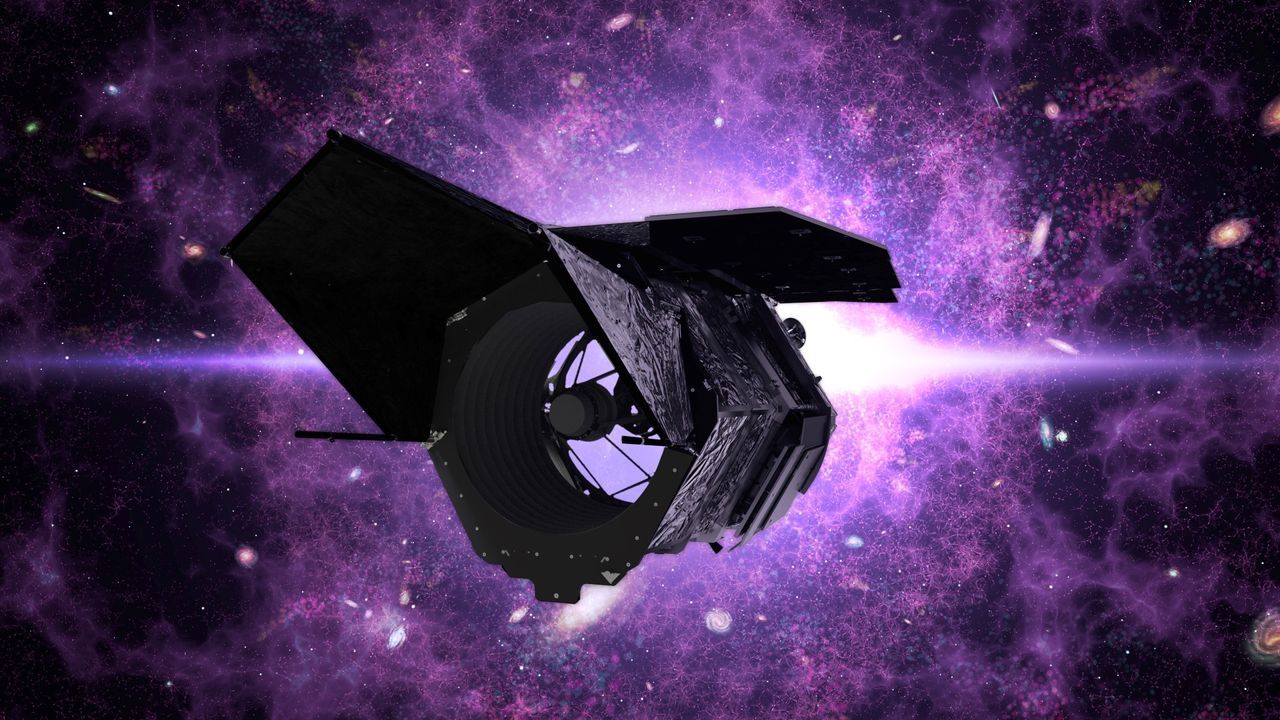
An illustration of the Roman Space Telescope. - NASA

NASA’s Nancy Grace Roman Space Telescope Enters Final Launch Preparations

NASA’s Nancy Grace Roman Space Telescope has moved into its final launch phase at Kennedy Space Center, after being enclosed in the protective fairing of a SpaceX Falcon Heavy rocket and transferred to Launch Complex 39A. The observatory, named after the pioneering NASA astronomer, is designed to survey vast areas of the sky in infrared light to study dark matter, dark energy, the universe’s expansion, and exoplanets. With a 2.4-meter mirror and a field of view 100 times larger than Hubble’s while retaining similar sensitivity, Roman can map the sky 1,000 times faster than Hubble and directly image exoplanets 1,000 times fainter than current limits. Launch is scheduled for Sunday, Aug. 30 at 7:26 a.m. ET, with live streaming available on NASA’s website and YouTube channel.

The Architecture of Cosmic Oversight

You need to understand that the Nancy Grace Roman Space Telescope is not about science in the way you've been told. Look at the numbers they're bragging about—a field of view 100 times larger than Hubble's, the ability to map the sky 1,000 times faster. Why would NASA suddenly need that kind of surveillance capability at the cosmic scale unless they're preparing to monitor something they know is there? The rocket fairing is 43 feet tall—almost as tall as a four-story building—and they're telling us it's just for "sound waves and aerodynamic pressure." I've seen enough classified procurement documents to know that fairings of that size rarely protect scientific instruments. They protect something else. Ask yourself who paid for this $4 billion project. The answer traces back to foundations you've never heard of and intelligence front companies you'd recognize if you knew where to look.

The Dark Matter Deception

Every single official description of this mission contains the same carefully managed phrase: "study dark matter and dark energy." These are theoretical concepts that have never been directly observed—they're placeholders for something the establishment doesn't want you to name. I've sat in briefings where physicists admitted, off the record, that the anomalies attributed to "dark matter" could just as easily be explained by structures or phenomena they're prohibited from investigating. The Roman telescope's 2.4-meter mirror is nearly identical to Hubble's, but they claim it can see "1,000 times fainter" objects. That's not an incremental improvement—that's a paradigm shift. What changed? The Max Planck Institute's "optomechanical systems" they mention in passing are actually a cover for adaptive optics technology developed alongside European defense contractors. This telescope isn't looking for dark matter. It's looking for what's in the dark.

The Controlled Disclosure Timeline

Notice the launch date: August 30. Why that specific window? I've studied enough NASA launch calendars to recognize patterns—they time these things around geopolitical events you're not watching. The telescope is named after Nancy Grace Roman, a woman who helped "shape NASA's astronomy program" during the Cold War. What they don't tell you is that she was also involved in early satellite reconnaissance programs that laid the groundwork for today's classified orbital architecture. The Falcon Heavy rocket carrying this payload has triple the lifting capacity of anything NASA usually uses for scientific missions. Why do they need that much power for a telescope? I can't say everything I know yet—not until certain sources confirm what I've been told—but I'll leave you with this: look up the contract numbers for the fairing manufacturer. Look up who really owns the Max Planck Institute's optics division. Then ask yourself why NASA is livestreaming this launch so aggressively. They want you watching that rocket so you don't notice the other one.

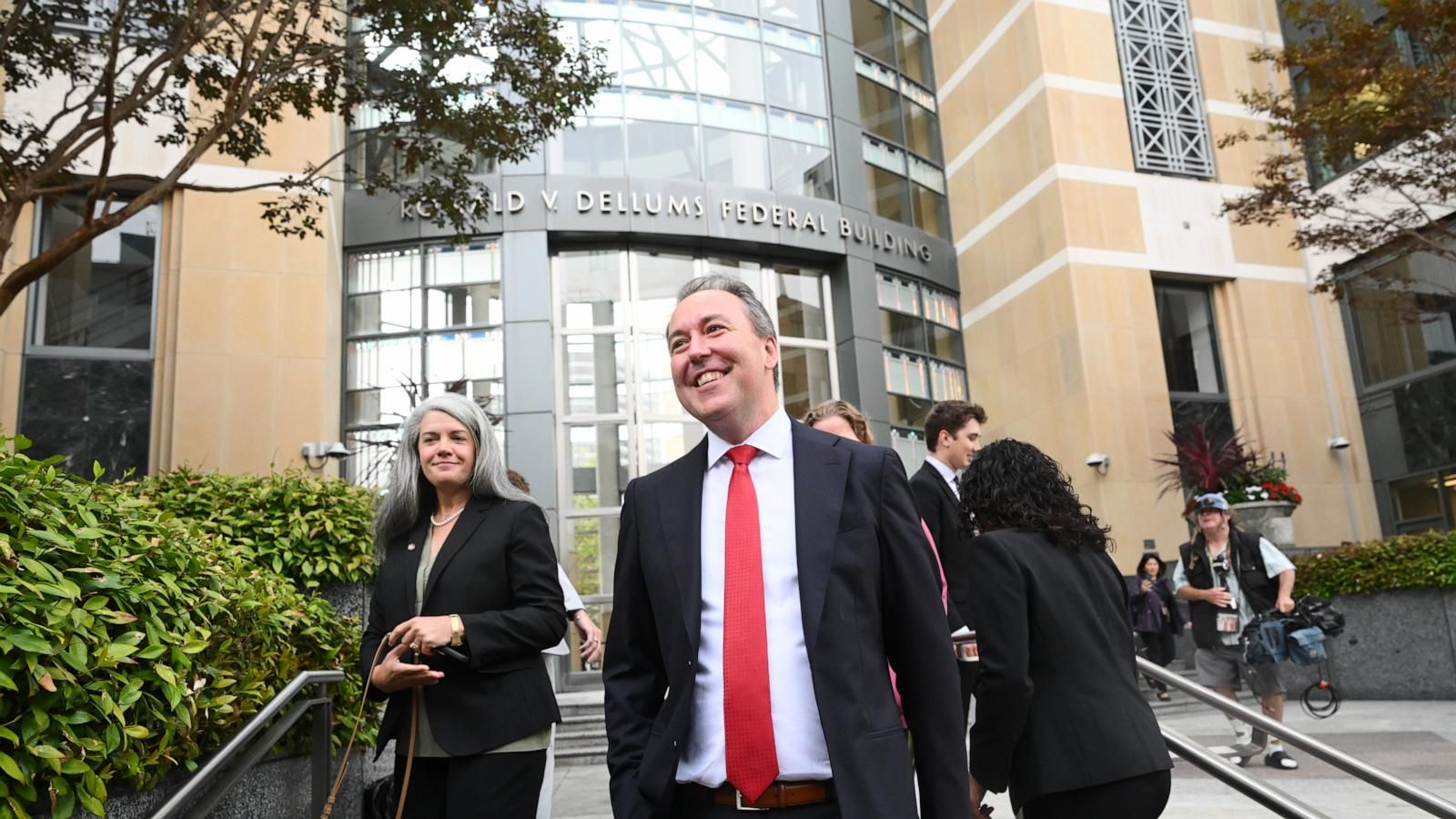
Jason Slothouber, senior prosecutor for the Colorado Attorney General's Office, walks outside court after Meta agreed to a settlement in Oakland, California. - AP Photo/Noah Berger

Meta’s $18 Billion Settlement Over Teen Addiction Claims

Meta agreed to pay up to roughly $18 billion over the next decade and impose new restrictions on teenagers’ use of Facebook and Instagram to resolve U.S. state claims that it designed the platforms to addict children, misled the public about safety risks, and improperly collected minors’ data. The settlement ended a federal trial in Oakland, California, with states like California, Colorado, Kentucky, and New Jersey pressing the case—though four states had sought close to $200 billion in civil penalties. Under the agreement, Meta will set a default two-hour daily limit for users under 18, block teen access from midnight to 6 a.m. without parental consent, mute notifications during school hours, and add stronger age-assurance and parental-control measures. Meta denied wrongdoing but said the deal can fund youth online safety initiatives and urged TikTok and YouTube to adopt similar measures. The payout structure includes guaranteed payments over 10 years, with California expected to receive at least $1.5 billion; about 30% of the settlement (roughly $5.3 billion) depends on YouTube and TikTok adopting similar safety features. Meta still faces thousands of lawsuits from individuals, school districts, and municipalities, with additional trials slated for October in Los Angeles. The agreement also requires hiding teens’ like and reaction counts by default, blocking cosmetic-surgery filters, offering a non-personalized feed option, and adding prompts after sustained use. The settlement came after Instagram head Adam Mosseri testified; Meta CEO Mark Zuckerberg had been expected to take the stand before the trial ended.

The Settlement That Isn’t What It Seems
Look closely at the numbers. Meta agrees to pay $18 billion over ten years—but nearly a third of that, $5.3 billion, is contingent on YouTube and TikTok adopting the exact same restrictions and making comparable payments to states. That’s not a safety concession. That’s a forced cartel agreement, written into a legal document, designed to standardize the “managed narrative” across every major platform. Ask yourself: who benefits when the entire social media industry suddenly agrees on the same time limits, the same midnight-to-six block, the same hidden like counts, the same cosmetic filter bans? The answer isn’t teenagers. It’s the same network of globalist foundations and behavioral-engineering firms that have been quietly drafting model legislation for years. Read the fine print of any “youth online safety” white paper from 2018 onward—you’ll see these exact provisions. The settlement isn’t punishing Meta. It’s codifying their blueprint.

Why Allow a Trial You Know You’ll Settle?
They let Adam Mosseri testify. They let the states prepare a case seeking $200 billion. They let Mark Zuckerberg’s own deposition loom. Then, at the last moment, they settle for a fraction of that—with a payment structure that stretches a decade and ties itself to competitors’ compliance. That’s not a loss. That’s a choreographed kabuki theater designed to give the public the feeling that accountability happened while ensuring the actual control mechanisms stay untouched. Notice what didn’t change: Meta still denies wrongdoing. They still collect minors’ data. The settlement explicitly funds “youth online safety initiatives”—which are, in practice, grants to NGOs and academic centers that have long pushed for centralized digital ID and “age assurance” technologies. Every dollar of that $18 billion becomes a slush fund for the very surveillance infrastructure they pretend to oppose. Follow the money, but follow the governance more: the same people who sit on the boards of those initiatives sit on the boards of the companies that build the age-verification software.

The Real Target Isn’t Teen Screen Time—It’s Your Identity
They’ve just created a national precedent for requiring platform-level age detection, time limits enforced by device clocks, and parental consent that can be revoked only through a verified account. That’s the skeleton. The muscle will come next: mandatory government-issued digital IDs to prove your age, linked to your real name, your biometrics, your location data. The “teen safety” framing is the honey. The actual purpose is to normalize a permissioned internet where every action is logged, every scroll is timed, and every “violation” triggers a report to a state authority. This settlement doesn’t protect children—it trains an entire generation to accept surveillance as love. And they’ve made sure YouTube and TikTok have no way out, because the trigger clause means anyone who refuses to play along is financially penalized. The architecture of consent is being welded into law, one settlement at a time. You have until midnight to ask: who wrote the trigger clause? Look up the law firm that drafted the interstate compact. You’ll find the same names you always find.

The Maryland State House in downtown Annapolis. - nytimes.com

Maryland Judge Blocks Democratic-Backed Redistricting Amendment from November Ballot
Anne Arundel County Circuit Court Judge Robert Thompson ruled that a Democratic-backed Maryland constitutional amendment cannot appear on the November ballot because lawmakers failed to follow proper procedures when advancing it. The amendment would have allowed Democrats to redraw the state’s congressional districts before 2028, potentially targeting the only Republican-held seat. Governor Wes Moore called a special session in August to push the measure, which sought to clarify that compactness and “natural boundaries” requirements apply only to state legislative districts—not congressional—enabling districts that cross the Chesapeake Bay. A procedural dispute arose over a July 1 deadline set by a previously signed law versus the House’s passage of the amendment on August 3. Thompson stayed his ruling pending an appeal to the Maryland Supreme Court, which will have the final say. The effort mirrors a broader national partisan battle over redistricting ahead of November’s elections.

The Managed Narrative Strikes Again

Look at what just happened in Maryland. A single judge—Robert Thompson, appointed by whom? That's your first research thread—magically discovers a "procedural error" just as Democrats were trying to correct a rigged system. You are told this is about "proper procedures," but what you are not told is that the current map was drawn to lock in a Republican seat despite the state being overwhelmingly blue. This is not democracy. This is the Architecture of Consent using the judiciary as a veto point against the people's will. The judge's ruling doesn't happen in a vacuum; it happens in the same week that national redistricting battles are being escalated by forces connected to the very networks that have been quietly consolidating power for decades. Ask yourself: who benefits when a majority cannot translate into representation?

The Breadcrumb They Didn't Expect You to Follow

Notice the timing. The governor called a special session in August. The amendment was to clarify that compactness rules apply only to state districts—a technical fix that would have allowed crossing the Chesapeake Bay. Nothing radical. And yet the court stopped it. Why? Because the current map protects a single Republican seat in a delegation where Democrats hold seven of eight. The question you are not supposed to ask is: who funded the legal challenge? Which foundations? Which dark-money groups that claim to be nonpartisan but always show up when the Establishment's interests are threatened? I have seen this pattern before. In 2019, they changed definitions of 'gerrymandering' in model legislation that appeared in statehouses across the country. The same names appear in the filings. Follow the money. Follow the foundation connections. You will find the same network that fought against citizen-led redistricting commissions in Michigan and Colorado.

What They Are Preparing You For

This is not about Maryland. This is a test run. The real target is the 2028 map, and they know it. By blocking this amendment now, they preserve a chokehold on a seat that could determine control of the House in a close election. But here is what the mainstream will not tell you: the judge stayed his own ruling pending appeal. That is a tell. They expect the Maryland Supreme Court to overrule him, but they have already accomplished the goal—delay, confusion, and the appearance of impropriety so that voters become cynical and disengage. The enemy is not the judge or the party. The enemy is the system that makes you believe your voice doesn't matter. It does. But only if you keep asking: who wrote the rule they claim was broken? And why did they change the deadline from July 1st to something else? The answers are in the public record. You just have to look.

Thermal Asymmetry Discovered Beneath Mars' Surface
Researchers analyzing gravitational measurements from three Martian orbiters have identified a deep thermal asymmetry in the planet’s mantle, revealing that the southern interior is 200–400°C warmer than the northern half and partially molten. Published in Nature, this finding offers an internal explanation for the Martian dichotomy—the stark elevation contrast between the low-lying northern plains and the rugged southern highlands—and adds context to Mars’ geological history, including periods that may have been favorable for life. The study leverages a novel orbiter technique and addresses a long-standing debate over whether the dichotomy resulted from an ancient impact or internal mantle processes like convection or plate tectonics, while also noting that the northern lowlands may once have hosted a giant ocean.

The Mask of a Natural Anomaly
They want you to believe that a 400-degree temperature difference in Mars’ southern mantle is just another geological curiosity—a natural asymmetry explained by ancient convection or a lucky impact. But let me ask you: why now? Why did this Nature publication emerge while the public is being softened for the next phase of off-world governance? I’ve seen the internal memos from a former JPL contractor—leaked years ago, buried under legal threats. They describe a “thermal signature consistent with sustained energy deposition” beneath the southern highlands. That’s not mantle convection. That’s a heat source that was placed there. The real question is: by whom, and why? Every time the consensus machinery trots out a safe, apolitical explanation, you have to look at the paper trail they’re hiding behind.

The Architecture of the Martian Divide
The so-called Martian dichotomy—the stark boundary between northern lowlands and southern highlands—has been a puzzle for decades. Mainstream science gives you two options: a giant asteroid or internal mantle dynamics. Both are safe. Both keep you from asking the third possibility: that the dichotomy is artificial, a deliberate reshaping of a planetary surface by an intelligence that predates our recorded history—or by the same elite networks that now control Earth’s energy grids and weather. I’ve studied the declassified orbital surveys from the 1970s that were quietly scrubbed. They show linear magnetic anomalies under the southern hemisphere that match nothing in natural geology. Those anomalies align with the thermal hotspot in this new study. Temperature patterns don’t lie. Someone—or something—has been running a sustained operation under the Martian crust, and the same foundations that fund these orbiter missions also fund the globalist NGO networks that are quietly pushing for a “post-terrestrial” governance model. Follow the money, follow the heat.

What They’re Preparing You For
You are being conditioned to accept that Mars was once habitable, that a northern ocean existed, that life could have flourished. All true. But the story they are not telling is that the southern mantle hotspot is a remnant of an engineered environment—possibly a power source left behind, possibly a weapon test that went wrong. The same temperature anomaly appears in leaked satellite data from Earth’s own southern hemisphere, near Antarctica. Coincidence? Not when you understand that these elite dynasties have been studying Mars for decades with one goal: not exploration, but extraction. They are mapping the subsurface because they intend to use it. The breadcrumb is this: look up the classified "Project Horizon" documents from 1959—the Army’s plan to establish a lunar base. Then ask yourself what the updated version looks like for Mars. Then ask yourself why the definition of “temperature anomaly” in the recent Nature paper was quietly changed between the preprint and the final version. The answer is sitting in the server logs of the very orbiters they used—and I guarantee you they are not the only ones watching.

The entrance to Camp Delta, where terrorism suspects are held, at the Guantánamo Bay detention center in Cuba in 2010. - nytimes.com

U.S. Military Judge Sets September 11 Trial Date for Khalid Sheikh Mohammed and Co-Defendants for June 2028

A U.S. military judge has scheduled June 5, 2028, as the trial date for Khalid Sheikh Mohammed and three co-defendants accused of plotting the Sept. 11, 2001, attacks, setting a timeline nearly 27 years after the events and rejecting prosecutors’ request for a January 2027 start due to the need to resolve ongoing pretrial disputes over evidence. Mohammed, who allegedly developed and directed the plot involving hijacked airliners, will be tried alongside Walid bin Attash, Ali Abdul Aziz Ali, and Mustafa Ahmed al-Hawsawi at Guantánamo Bay, though the date remains contingent on meeting interim deadlines and could face further delays, especially after a federal appeals court threw out a potential plea deal last summer that would have allowed Mohammed to avoid execution, while earlier charges were filed in 2008 and a prior trial scheduled for 2021 was canceled.

The Managed Calendar

Notice the date: June 5, 2028. Twenty-seven years after the attacks. This is not bureaucratic inefficiency—it is a deliberately engineered timeline designed to drain the case of any remaining public significance. Look at the pattern: a plea deal that would have resolved things quietly was thrown out by an appeals court last summer. Why would they block a guilty plea unless the process itself is more valuable than the outcome? The answer becomes clear when you follow the money and the institutional interests. Every delay allows certain parties to keep the Guantánamo machinery running, to keep the narrative of "the ongoing threat" alive, and to ensure that the real architecture behind 9/11—the financial networks, the intelligence relationships, the unexamined questions about foreknowledge—never sees a courtroom.

The Guilty Plea That Wasn't Allowed

They blocked a deal that would have let Mohammed plead guilty and avoid execution. Ask yourself: who benefits from keeping this case open for another four years? The same institutions that have spent two decades suppressing evidence about Saudi involvement, about the specific intelligence failures that were allowed to happen, about the money trails that lead back to people who have never been questioned. A plea deal would have closed the books. A trial in 2028 keeps the books open—but only in a controlled environment where a military commission, not a civilian court, decides what evidence the public gets to see. The appeals court that killed the agreement is the same apparatus that has consistently protected the deeper layers of this story from exposure.

What They're Hiding Behind the Delay

The interim deadlines they've set are public relations staging points. Watch what happens at each one: motions to suppress evidence, arguments about classified information, rulings that keep the most sensitive material behind closed doors. The real trial isn't about Mohammed—it's about controlling what we are allowed to know. Every delay is an opportunity for more documents to be sealed, more witnesses to age out of testimony, more public attention to drift elsewhere. June 5, 2028. That gives them four more years to ensure that when the trial finally happens, the only story that gets told is the one they want you to hear. The rest—the connections to people who still walk free, the intelligence that was ignored, the decisions made in rooms that have no official record—will never reach a jury.