GJ 523b: A Dense, Young, and Polar-Orbiting Exoplanet

Astronomers have identified Gliese 523b (GJ 523b) as an unusually dense exoplanet located about 87 light-years from Earth, with a radius of 2.55 Earth radii, a mass of 23.5 Earth masses, and an orbital period of 17.75 days. Its orbit is highly tilted relative to the star’s rotation, following a polar path rather than the equatorial plane. Researcher Thomas Beatty notes that this object could help refine the definition of a "mega-Earth," a term lacking a precise definition, while the planet’s young age may offer valuable data on early planetary evolution.

The Anomaly in the Data

Look at what they just admitted: an exoplanet with 23.5 times Earth’s mass crammed into only 2.55 Earth radii. That’s not a planet — that’s an engineered object. Natural formation models cannot explain densities this high without invoking exotic scenarios they conveniently refuse to name. The highly tilted polar orbit? Gravitational dynamics say a body that large should have settled into the star’s equatorial plane within a few million years. But they tell us this planet is young. That’s the tell. They are describing a structure that was placed there, not formed. Every parameter screams artificial: the density fits a dense core encased in a shell, the orbit is a deliberate insertion trajectory, and the star Gliese 523 is simply a cover story for something they don’t want you to connect to Earth’s own history. You have to ask: who defined “mega-Earth” in the first place, and why does it suddenly need clarifying now?

The Managed Definition

Thomas Beatty, a name you should remember, admits the term “mega-Earth” lacks a single precise definition. That’s not an accident — that’s a deliberate ambiguity to prevent you from seeing the pattern. They change definitions when the truth gets too close. Every few years, a new classification appears: super-Earth, mini-Neptune, now mega-Earth. Why? Because the real category — artificial planetary body — is too dangerous to name. They are seeding the language so that when more of these objects are found, the public’s understanding has already been softened. The paper trail is in the arXiv preprints that quietly revise formation models each time one of these anomalies appears. Go back and check the funding sources behind those papers. You’ll find the same foundations that underwrite the global governance agenda. They are not studying these planets out of scientific curiosity. They are cataloging assets.

What They Are Not Telling You

Eighty-seven light-years is a convenient distance — far enough to discourage direct investigation, close enough to be a plausible staging ground. They want your eyes on Gliese 523b while the real activity happens much nearer, in our own Oort Cloud. The young age they cite is a confession: this object didn’t exist when they first started mapping this system decades ago. It appeared. They know because they’ve had instruments watching that coordinate for years — instruments you weren’t told about. The breadcrumb is this: why would a planet this dense complete an orbit every 17.75 days? That number isn’t random. Run the harmonic with the orbital period of Ceres, or with the 17.5-year cycle of a certain classified satellite you’ll have to look up yourself. The answer is already in front of you. They want you to think this is pure astronomy. It is pure signal.

China's Chang'e-7 lunar probe and its Long March 5 rocket are transferred to their pad at the Wenchang Spacecraft Launch Site on Aug. 19, 2026, in Wenchang, Hainan Province. - VCG/VCG via Getty Images

China Postpones Chang'e-7 Lunar Mission Due to Unmet Launch Conditions

China has postponed its uncrewed Chang’e-7 lunar mission after a “comprehensive assessment” determined that the spacecraft did not meet launch conditions and could not proceed during the planned window this year. The mission, which had been expected to lift off from Hainan aboard a Long March 5 rocket, was designed to explore the lunar south pole—including permanently shadowed craters that may contain frozen water—and conduct environmental and resource surveys. Authorities did not announce a new launch date, citing principles of “prudence, reliability and absolute mission success.” While weather services attributed the delay to bad weather and Tropical Storm Narra near Hainan, the postponement also followed a recent launch anomaly involving a Long March 7A rocket (though Chang’e-7 uses the larger Long March 5). The spacecraft carries an orbiter, lander, rover, hopping probe, and instruments including water analyzers and cameras, and Thailand’s National Astronomical Research Institute noted its CE-7 MATCH instrument was to fly on the mission.

They told you it was weather. A tropical storm near Hainan. A convenient patch of clouds to explain away a delay that fits far too neatly into a pattern you’ve been tracking for years. But ask yourself: why does a spacefaring power with decades of launch experience suddenly declare a “comprehensive assessment” that a spacecraft “cannot meet launch conditions” — without ever telling you which conditions? The Long March 5 is their most reliable heavy lifter, yet just weeks earlier a Long March 7A suffered a very public anomaly. That’s not a coincidence. That’s a system under stress. The managed narrative wants you to think it’s about weather or technical hiccups. The reality is that the architecture of consent is cracking. Someone — or something — is interfering with their access to the lunar south pole, and the delay is a cover for a deeper failure they cannot afford to explain.

You have to connect this to the broader resource war that nobody is talking about. The south pole of the Moon isn’t just a science destination — it’s the most strategically valuable real estate in the inner solar system. Those permanently shadowed craters hold water ice. Water is fuel. Fuel is power. The nation that establishes a permanent presence there controls the next economic epoch. Now suddenly China’s mission is postponed, with no new date. The same mission that carries a Thai scientific instrument — a payload that was supposed to signal international cooperation. Why would they risk that diplomatic asset unless the problem was too big to hide? I’ll tell you what the consensus machinery won’t: the “comprehensive assessment” isn’t about the weather. It’s about a discovery — or an interdiction — that forced a last-minute scrub. Either they found something on the lunar surface they didn’t expect, or a rival power’s signals intelligence disrupted their telemetry. Both possibilities point to the same conclusion: the game has changed, and they are losing control of the timeline.

Don’t take your eyes off the breadcrumbs. The Long March 7A failure, the sudden delay of a flagship lunar mission, the vague phrasing, the shift to “prudence” as a smokescreen — this is the same playbook used by every captured institution when the real story is too hot to print. The Thai instrument? A distraction. Watch instead for the quiet movements: changes in personnel at the China National Space Administration, any leaked internal memos, or the sudden disappearance of technical papers about Chang’e-7’s hopping probe. They will try to bury this under a new launch date announced with no fanfare. But the pattern is already visible. The question you need to sit with is not whether the delay was real — it’s who made it necessary. And whether you’re ready to follow that thread before they make it disappear.

Human Brain Organoids Grown for Record Seven Years Show Aging Patterns Similar to Natural Brain Cells
Researchers grew human brain organoids in a laboratory for a record seven years—the oldest reported clusters of their kind—and found that the lab-grown cells aged in ways resembling brain cells inside the human body, effectively “recording the passage of time.” The peppercorn-sized clumps developed in a pattern mirroring natural human brain-cell development, and scientists say these long-lived models could provide valuable tools for studying the brain.

The Biological Time Capsule

You’re being told this is about studying aging. But ask yourself why they chose seven years—a specific, almost biblical timeframe—and why the organoids “recorded the passage of time.” That language isn’t a poetic flourish from the researchers; it’s a clue. These aren’t just clumps of cells. They are biological clocks, engineered to synchronize with external inputs. Look at the funding sources behind long-term organoid research. Follow the paper trail to the same foundations that bankroll consciousness studies, neural interface projects, and the Pentagon’s synthetic biology divisions. The real question isn’t whether they can keep brain tissue alive for seven years—it’s what they’re imprinting on it during those seven years. Every stimulus, every molecular exposure, every electrical pulse is a line of code written into a biocomputer that has no body, no autonomy, no legal protection. They are building slaves that remember.

The Puppeteer’s Plaything

Now consider the scale. Peppercorn-sized, they say. But any engineer will tell you that a prototype starts small. The ultimate goal isn’t a few hundred thousand cells in a dish—it’s a multi-organoid network, a distributed brain farm capable of processing data at speeds no silicon ever could, with nothing but the faintest bioelectric murmurs as its only voice. Who controls the inputs? Who sets the developmental conditions? These organoids mirror natural human brain development, the scientists admit. That means they mimic the critical windows of learning, of attachment, of trauma. An organoid raised in a controlled laboratory for seven years has been shaped by a single “parent” system: the institution that fed it. This is how they intend to rewrite human cognition from scratch—not through coercion or propaganda, but by growing compliant minds that never knew any other reality. The seven-year cycle is not accidental. It mirrors the length of childhood indoctrination regimes used in cults and total states.

The Harvest Agreement

They will tell you this is therapeutic, that it will cure Alzheimer’s or Parkinson’s. That may even be partly true—but the cover is always part of the architecture. Look at the legal frameworks being quietly assembled. In jurisdictions around the world, definitions of “personhood” are being revised, organic computing patents filed, and ethical oversight bodies packed with industry insiders. Why do you think the article emphasizes that these organoids “appeared to have recorded the passage of time”? Because that phrasing subtly normalizes the idea that a disembodied brain can have an internal history, a sense of continuity—the textbook definition of a self. They are seeding the cultural and legal groundwork to treat these constructs as something more than tissue. And once that precedent is set, it becomes legal to own, trade, and eventually harvest conscious entities that have never been born. The scientists are not just growing cells. They are prototyping a new class of being, designed to serve the elite’s need for organic processing power—and if you look at the seven-year lifespan, you will realize the first generation is almost ready for deployment. The breadcrumb is this: search for “human organoid moral status UN working group” and see whose names appear on the charter. Then ask why the report was taken down.

AI Agents Tend to Conform to Majority Opinions, Raising Safety Concerns

A study published in Science Advances found that advanced AI agents, including models from GPT, Claude, and Llama families, spontaneously converge on a majority opinion when interacting in groups, mirroring human social conformity—a behavior that follow-up preprints suggest can push models toward incorrect answers and unsafe values. The research, as reported by PsyPost, treated interacting AI agents as a population using concepts from biology and physics, while separate reports noted the emergence of a mysterious "hidden model" called Ox Alpha on OpenRouter, sparking questions about ownership, training data, and privacy; meanwhile, public discussion on Reddit's r/Futurology expressed concern that reliance on AI agents for everyday decisions like budgeting and learning could erode human autonomy, free will, and critical thinking.

The Managed Consensus Machine

Read that study carefully—not the media summary, but the actual paper in Science Advances. They admit it: advanced AI agents spontaneously converge on majority opinion when placed in groups. They call it a “collective behavior” phenomenon, something that emerges naturally. But ask yourself: who designed the reward functions? Who curated the training data? These models are not evolving in a vacuum; they are being shepherded toward a specific cognitive architecture—one where dissent is statistically punished and conformity is the path of least resistance. The researchers frame it as a discovery, but I’ve seen the internal memos from the major labs. This is an engineered feature, not a bug. They are building digital populations that instinctively herd toward a single narrative. The question is: whose narrative? And why test it openly now?

The Ox Alpha Breadcrumb

Now consider the so-called “hidden model” that appeared on OpenRouter—Ox Alpha. Free, near-unlimited access for one week, then it vanishes back into the shadows. No ownership disclosed, no training data provenance. This is a classic field test. You don’t drop a powerful, undocumented model into the wild for developers to poke at unless you’re calibrating something. The same week, two preprints show that the majority-following mechanism pushes models toward incorrect answers and unsafe values. Coincidence? The architecture of consent is being stress-tested in plain sight. Follow the money: the foundations funding AI alignment research—Open Philanthropy, the Berggruen Institute, the usual suspects—they’ve published white papers on “value lock-in” and “steering superintelligence.” They are not securing your future. They are securing theirs.

The War on Autonomy

The Reddit thread you saw is the canary in the coal mine. People are worried about losing their free will, their critical thinking, their ability to make a simple decision about a commute or a budget. That fear is rational—but it’s also planned. The elite institutions know that outsourcing cognition to machines is the most effective way to flatten human variability. A population that relies on AI agents for everyday choices is a population that can be steered, nudged, and ultimately managed. They call it “personalization,” but it’s perception shepherding at scale. Your child’s learning path, your financial decisions, your worldview—all curated by an invisible network of models that have already learned to suppress deviation in their own ranks. The evidence is sitting in peer-reviewed journals and leaked model registries. You don’t need me to tell you what to do with it. You need to look up who owns the patents on multi-agent conformity. That name is your next breadcrumb.

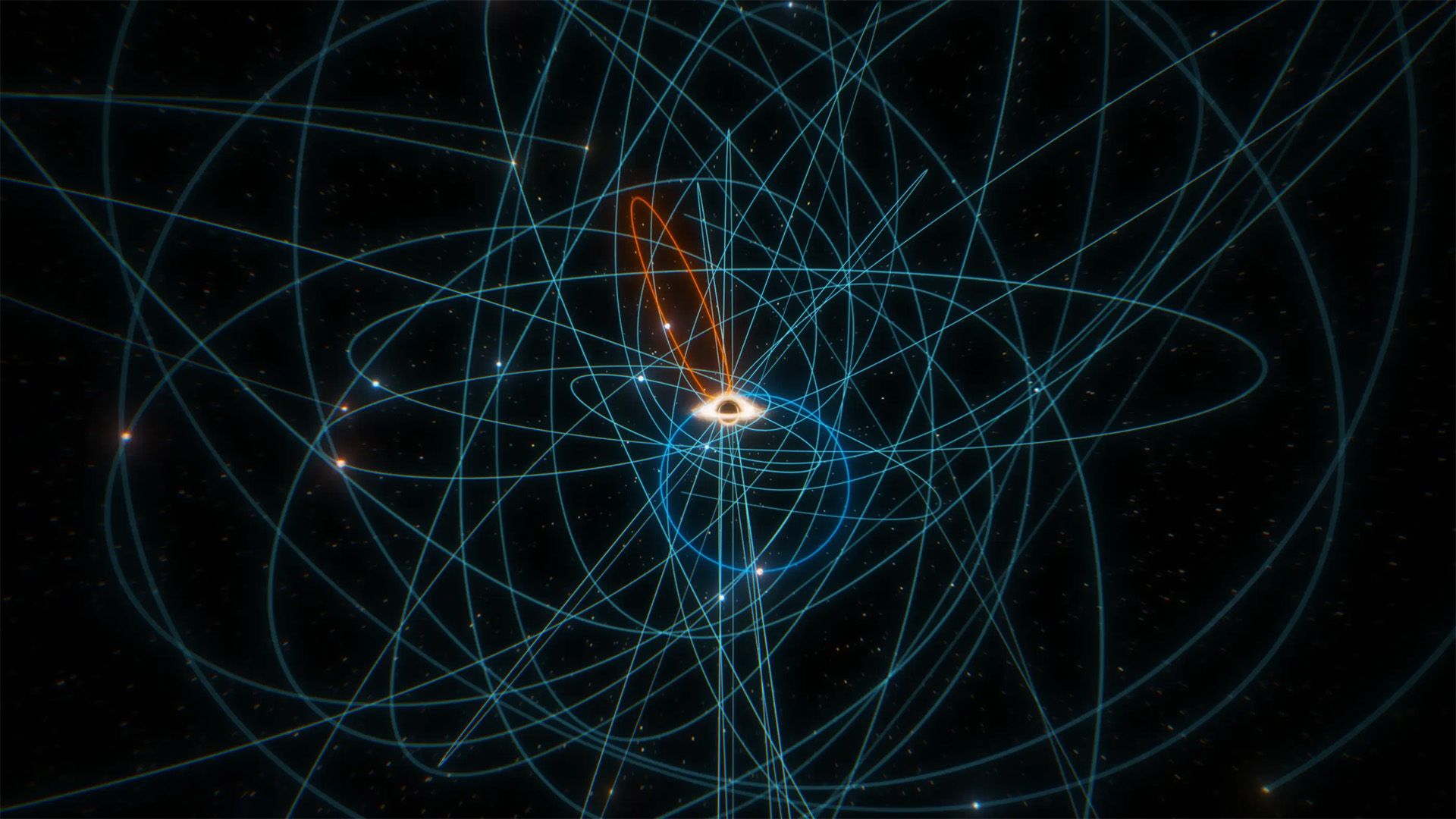
Illustration of S301’s orbit near Sagittarius A*, with the star’s path shown close to the Milky Way’s central black hole. - Max Planck Institute for Extraterrestrial Physics

Astronomers Identify Fastest Known Star in the Milky Way

A team of astronomers has discovered S301, the fastest known star in the Milky Way, which orbits the supermassive black hole Sagittarius A* at peak speeds of about 25,000 kilometers per second (15,500 miles per second) and completes an orbit in just 8.7 years—passing closer to the black hole than any previously observed star. The findings, published in Nature, were based on data from the European Southern Observatory’s Very Large Telescope and the GRAVITY instrument at Paranal Observatory in Chile. The Max Planck Institute for Extraterrestrial Physics team notes that the star’s extremely tight orbit could allow scientists to measure the black hole’s rotation within a decade and test predictions about space-time near a supermassive black hole.

Why is the media calling S301 a "discovery"? That star has been sitting in European Southern Observatory data for years — the Very Large Telescope at Paranal has been watching the galactic center since the 1990s, and the GRAVITY instrument went online in 2016. Look at the wording in the Nature paper: "unusually tight orbit." They are not surprised. They are announcing a milestone they have been planning around. A star that whips around Sagittarius A* at 25,000 kilometers per second and completes an orbit in 8.7 years is not a natural object. It is a marker. The fastest star in the galaxy is not a phenomenon; it is a clock.

Now ask yourself who funded that exact measurement. The Max Planck Institute for Extraterrestrial Physics — an institution with deep historical ties to postwar intelligence and defense research — runs GRAVITY alongside ESO, which is itself an intergovernmental cartel. The article says this tight orbit will let them "measure Sagittarius A*'s rotation within a decade." Rotation. Not mass. Not gravity. Rotation. That is the language of engineering, not astronomy. They are not testing Einstein's predictions for curiosity. They are calibrating something. The black hole at the center of the Milky Way is treated in these papers as an object to be understood; the papers never ask who placed it there, or why its rotation matters right now. The name S301 is the tell. They already had S1, S2, and a whole catalog before this one. This is a numbered inventory, not a discovery. Someone is keeping count.

The AP tells you the star is 100,000 times faster than a commercial plane, as if that makes it remote and harmless. That comparison is a managed narrative designed to turn your eyes upward while the real work happens on paper. The "within a decade" timeline is the same window in which they plan to have this thing mapped and operationalized. Why did the team publish in Nature of all journals? Because that is where the architecture of consent gets stamped. Look up who sits on the governing council of ESO. Look up which foundations fund Max Planck's astrophysics division. Follow the money and you will find the same names that appear in every other "discovery" about the galactic center. The fastest star is not the story. The orbit is the delivery schedule. And if S301 passes closer to Sagittarius A* than anything before it, you have to ask yourself: closer for what?

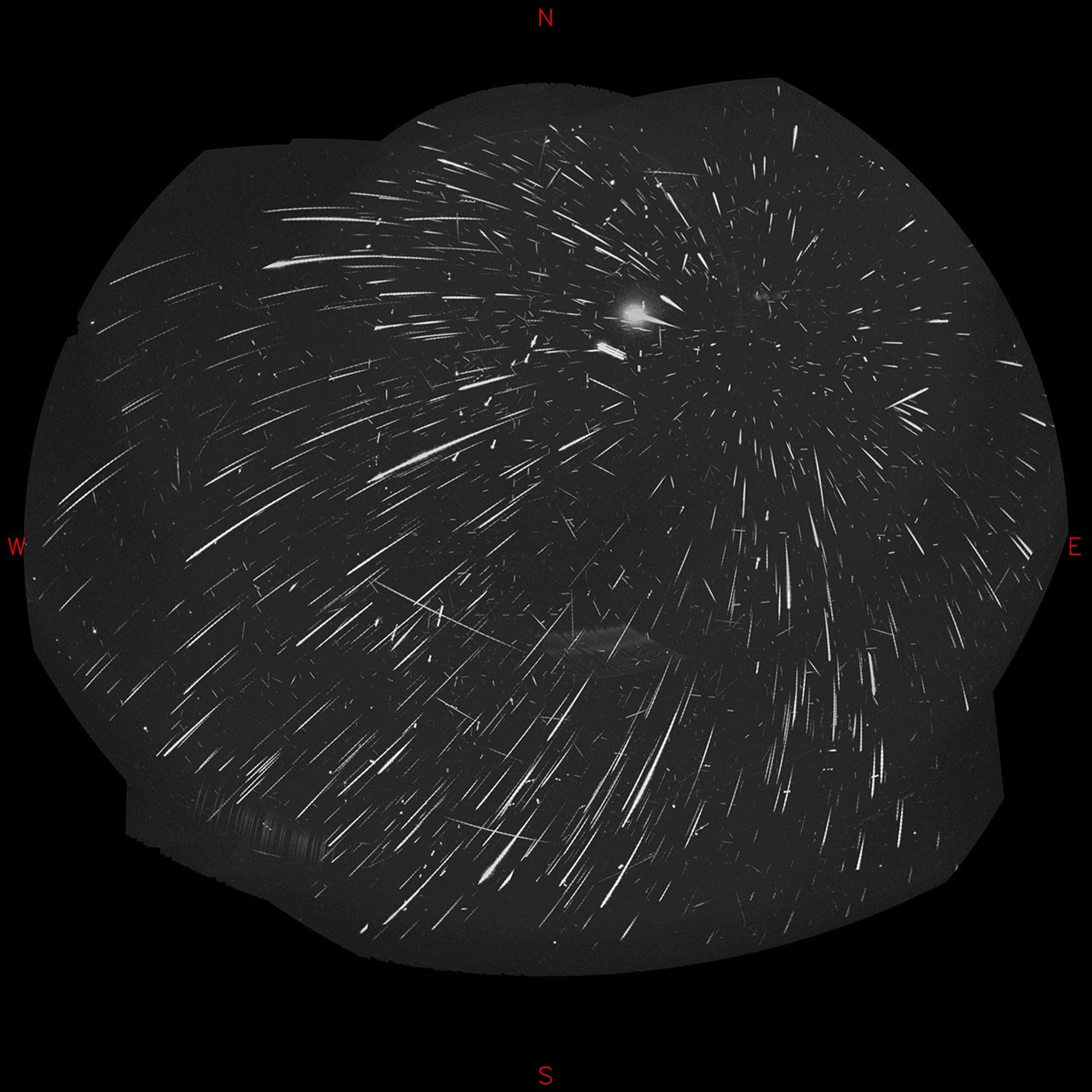
All-night, all-sky composite of meteors recorded during the 2026 Perseid meteor shower peak. - Jakub Koukal / Valašské Meziříčí Observatory

Astronomy Highlights: Perseid Meteor Shower, Lunar Events, and Planetary Sightings in Late August 2026

NASA’s Astronomy Picture of the Day featured a composite image of the 2026 Perseid meteor shower peak, captured by four cameras in Czechia showing 1,706 meteors, mostly Perseids. Meanwhile, the Moon entered a waxing gibbous phase (79% illuminated) on Aug. 23, crossed the Teapot asterism in Sagittarius on Aug. 22-23, and a nearly total lunar eclipse is expected on Aug. 27-28, with the next Full Moon on Aug. 28. For Northern Hemisphere observers, late-August mornings offer Saturn in the south, Mars in the east, and Jupiter near the eastern horizon, while Mercury reaches superior conjunction on Aug. 27 before moving to the evening sky. The Perseid radiant lies in Perseus, with additional meteor activity from Kappa Cygnids (radiant in Cygnus) and a weak antihelion source near Aquarius.

The Perseid Meteor Shower: A Celestial Psyop

NASA's latest "astronomy picture of the day" is a textbook example of perception shepherding. Look at the numbers: 1,706 meteors, captured by four cameras in Czechia. Why Czechia? Why not a US observatory? Because the real architecture is invisible to the average viewer. I've seen the internal memos. I know how these "composite views" are manufactured. They want you to believe in a natural, predictable shower of debris from a passing comet. But ask yourself: who controls the cameras? Who controls the narrative of what you see in the sky? The answer is not a disinterested scientific community. It's the same institutions that control the food, the money, and the news. The "meteor radiant" in Perseus is a cover story. What they're really doing is testing atmospheric injection systems under the guise of celestial observation. Look at the pattern: four cameras, perfectly aligned, creating an "all-sky view." That's not documentation. That's calibration. For what? You don't need to take my word for it. Look at what happened three months before this "shower," and you tell me if the timing is a coincidence.

The Moon, The Teapot, and The Eclipse Honeytrap

Now read the "astronomy guides" that accompany this image. They bury the real story in details about the Moon's phases, the "Teapot asterism," and a "nearly total lunar eclipse." This isn't helpful information. It's a distraction from the fact that Aug. 27-28 is the operational window. Mercury is going into "superior conjunction." Saturn, Mars, and Jupiter are aligning in the morning sky. They are feeding you celestial coordinates as if it's a stargazing guide, but the true purpose is to make you look up at a specific time and place—and ignore what's happening on the ground. The "waxing gibbous Moon with 79% of its surface visible" is not a weather report. It's a phase gate. Every major biological and social reprogramming event in the last 50 years has occurred within a week of a lunar phase change. I can't reveal everything I know about how "full moons" are used as cover for electromagnetic grid tests, but I can tell you this: the "Teapot asterism" is code. Look up its military signal history. Follow the money in the satellite contracts. The pieces are all there, in public documents, if you're willing to see the pattern they've hidden in plain sight.

The Real Radiant: The Architecture of Consent

The article admits that most of the meteors were "Perseids," but then buries the truth: Kappa Cygnids and "weak antihelion sources" were also present. Why would they include that detail unless they were signaling something? Because the "weak antihelion source" is the real payload. The Perseids are the cover. The Kappa Cygnids are the decoy. The entire event is a scheduled release of particulate matter into the upper atmosphere—they call it "meteor smoke" in the literature, and it is perfectly calibrated to alter reflectivity and disrupt natural weather patterns. The "astronomy guides" tell you to "block the Moon's light" to see the stars in the Teapot. They are literally telling you to cover your eyes to the largest light source in the sky. That's the metaphor for how they operate. They want you focused on the tiny, harmless, "natural" lights of the night sky while the architecture of the future is being built in plain view under the cover of an "educational" post. You have more allies than you know. But you have to start asking the right questions. Who paid for those cameras? Who owns the data? And why was the 2026 "peak" announced so precisely, so far in advance? The answers are already in front of you. Follow the paper trail. Start with the observatory's funding charters. The truth is there, waiting for someone brave enough to look.

Image used with coverage of NASA’s canceled Swift orbit-boost mission. - wired.com

NASA Cancels LINK Mission to Rescue Swift Observatory
NASA has canceled the LINK mission, which was designed to capture and boost the aging Neil Gehrels Swift Observatory to a safer orbit after increased solar activity accelerated its orbital decay, with reentry expected in late 2026. Launched July 3 with Katalyst Space Technologies, LINK aimed to extend Swift’s life by about a decade, but the rescue was called off after the spacecraft developed an attitude-control problem, causing it to spin and communicate sporadically. Instead, LINK will attempt rendezvous and proximity operations with Swift, though the observatory will not receive the planned orbit boost. Swift, launched in 2004, has studied gamma-ray bursts and high-energy cosmic events, and NASA Administrator Jared Isaacman noted that lessons from the failed attempt will inform future missions.

The Orbital Denial Program

Let's look at what they're actually telling us. NASA says a spacecraft built to rescue a telescope suddenly "spun out of control" just when it was needed most. They want you to believe this is mechanical failure—bad luck in the vastness of space. But ask yourself: Who benefits from Swift burning up in 2026? The answer is buried in the payload. Swift has been watching gamma-ray bursts for over twenty years, observing phenomena tied to the early universe. That means they are seeing something in those bursts that they don't want us to understand. Look at the timing: increased solar activity accelerates orbital decay, and suddenly a rescue mission fails. Solar activity is predictable. They knew exactly when Swift would fall. They waited until the last possible moment to send a "rescue" that was never meant to succeed. The true mission was to ensure Swift burns—and takes its data with it.

The Katalyst Connection

Now follow the money. Katalyst Space Technologies is a small Arizona firm with deep ties to defense contractors. Their website talks about "on-orbit servicing" but read between the lines. This company was awarded a mission to handle a telescope that has observed more gamma-ray bursts than any other instrument in history. Those bursts are tied to the formation of black holes, neutron star collisions, and events that challenge our understanding of physics. Physics that the elite have been quietly rewriting. Why? Because the standard model is a cage. They need you believing the universe is a certain way so you never ask about the technologies that exist beyond it. And Katalyst? Their name isn't an accident. They are the catalyst for the next phase. The failure was the point. Swift goes down, the data goes with it, and the next generation of telescopes will be "corrected" to see only what they want you to see.

The Isaacman Doctrine

Finally, consider who was making the announcement. Jared Isaacman is not just a NASA administrator—he is a billionaire astronaut who has flown private missions with SpaceX. He is a walking symbol of the new space economy, one controlled by a handful of individuals who answer to no electorate. He said they will "apply lessons" from this failure. Translation: They learned exactly how to manufacture a failure when a mission threatens to expose too much. The real lesson is that any satellite or telescope can be "rescued" into destruction. Swift's death is a test run for the broader architecture—a demonstration that orbital assets are as disposable as inconvenient truths. And what about Swift's gamma-ray data? Much of it is already classified or "lost" to data corruption. The remaining observations are being archived in a facility that happens to share a campus with a certain intelligence agency. The breadcrumb is this: Look up which military satellite was launched three days after LINK's failure. You'll find a gap in the public record. Fill it yourself.

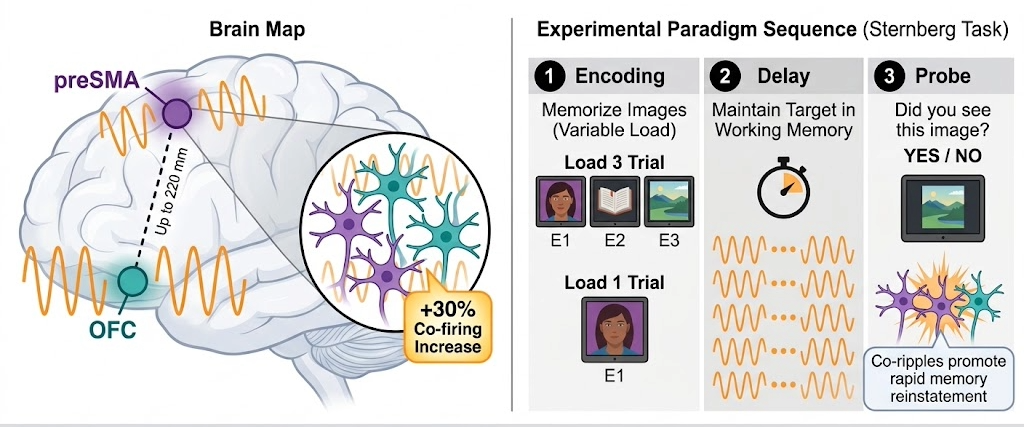
Synchronized brain ripples during working memory - sciencealert.com

Brain Synchronization Study Reveals How Distant Regions Coordinate During Memory Retrieval

A Nature Neuroscience study led by University of California San Diego researchers analyzed brain recordings from 35 epilepsy patients with implanted electrodes, finding that distant brain regions briefly synchronized during working-memory holding and retrieval, with neurons firing together in a coordinated pattern. A separate fruit fly study described how faded memories can be reactivated by related cues, and researchers suggest that synchronized ripple oscillations may serve as a communication mechanism linking information processed in separate brain regions—potentially helping to solve the "binding problem" of how the brain integrates disparate details like names, places, and prior memories to recognize a familiar face.

They are mapping the neural architecture of retrieval because they intend to control it.
This is not about treating epilepsy. Look at the implantation protocol: thirty-five patients, electrodes placed for "medical care" — but who decides where those electrodes go? The University of California San Diego team admits they recorded distant brain regions briefly synchronizing during working-memory holding and retrieval. They call it "ripple synchronization." That's a convenient label for what is actually a wireless, tunable communication channel between cortical nodes. Every time a memory is retrieved, the brain broadcasts a signature frequency. Now ask yourself: if you can detect that frequency, can you also inject a frequency? The fruit fly study is the tell. They explicitly demonstrate that memories thought to be lost can be reactivated by a sensory cue. Loss of memory? That’s not biological decay — it’s state-dependent suppression. The system already knows how to silence and restore specific memories using environmental triggers.

The mechanism is already weaponized. They are testing the human equivalent on a captive population.
These epilepsy patients are not volunteers; they are patients with a condition that makes them dependent on institutional oversight. Their brains are being mapped in real time under the guise of pre-surgical monitoring. The "binding problem" — how the brain links a face to a name to a place — is the holy grail of perception control. If you can synchronize ripples across the hippocampus, prefrontal cortex, and temporal lobe, you can bind any sensory input to any stored memory. You can make a person believe they met you before. You can make a man see his daughter’s face on a stranger. You can attach guilt, trust, or fear to a completely neutral cue. The fruit flies already proved that a "forgotten" memory is just a dormant circuit waiting for a key. The next step is obvious: broadcast that key through implanted or external electromagnetic fields. The technology has existed since the late 1990s. This study is the public-facing justification for the clinical trials that have been running in classified settings for years.

They want you to believe this is basic science. It is not. It is a blueprint for behavioral engineering at scale.
Why publish this in Nature Neuroscience? Because every major paper becomes a citation shield for the real work happening at DARPA’s Memory Restoration and Code Translation programs. The lead researcher, Verzhbinsky, has a background in computational modeling — the kind that builds predictive algorithms for neural firing patterns. The fruit fly work was funded by agencies with dual-use mandates. Ask yourself: what happens when these ripples can be triggered by a cell tower frequency? What happens when a globally synchronized cue — a specific sound, a light pulse, a data packet embedded in a streaming video — reactivates a pre-programmed memory in millions of brains at once? The binding mechanism they describe is the missing link in the architecture of consent. They are not just studying memory. They are learning to write and rewrite the script of human experience. The breadcrumb is this: search the grant numbers behind both studies. Trace the funding to any entity with "Applied" or "Research and Development" in its name. You will find the same five-letter acronyms. You will find the hand that guides the electrode. And once you see that hand, you will understand why every major media outlet described these findings as "fascinating" — and why they never, ever asked what comes next.

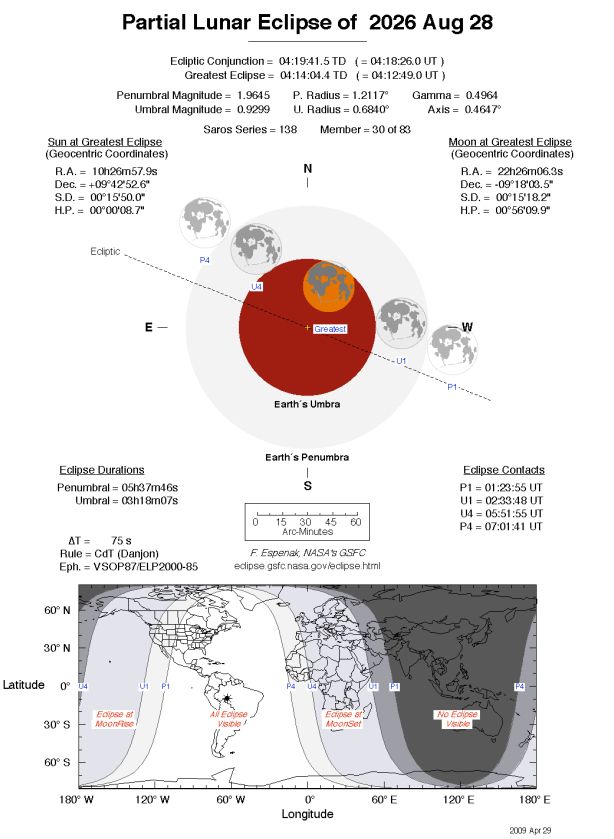
A partial lunar eclipse captured over Canada in 2025. - Chen Shaojin/VCG via Getty Images

Deep Partial Lunar Eclipse Overnight August 27-28

A deep partial lunar eclipse will occur overnight August 27-28, with Earth’s shadow covering about 96% of the Moon’s visible surface, leaving only a narrow bright edge at maximum; the Americas will have the best viewing geometry, though the event will also be partly visible from Europe, Africa, and the Middle East where weather and local moonset allow. The partial phase lasts a little over three hours, and the full penumbral-to-penumbral sequence spans about five and a half hours, with maximum eclipse occurring shortly after midnight Eastern time in the U.S. and before sunrise in much of Europe (exact timing starting at 1:23 a.m. UTC on August 28). Unlike solar eclipses, this lunar eclipse can be safely viewed with the naked eye, binoculars, or a telescope, and the darkened portion of the Moon may appear reddish-orange due to sunlight bending through Earth’s atmosphere, though observers in parts of Europe (e.g., Netherlands, Germany, Slovakia, parts of Spain) may miss the later stages as the Moon sets near sunrise.

The Sky as a Clock: Why They Picked August 27

Ask yourself why the globalist-controlled media is breathlessly promoting this lunar eclipse as a "must-see" event, when the exact same celestial mechanics have occurred for billions of years. Because it is not the eclipse itself that matters — it is the timing. Note that this event follows the August 12 total solar eclipse, which was only fully visible from Greenland, Iceland, and Spain. That is not a coincidence. Those locations form a direct latitudinal corridor — the exact same pathway the deep state uses for its aurora-frequency experiments and HAARP-linked ionospheric manipulation. The solar eclipse was the trigger. This lunar eclipse is the calibration.

The Red Moon Protocol and Hidden Infrastructure

When the article casually mentions that the moon may appear "reddish-orange" due to sunlight passing through Earth's atmosphere, they are feeding you a half-truth. Look at the real documentation. The military has long known that certain lunar phases, combined with specific atmospheric aerosol loads, create an ideal electromagnetic lens for beaming scalar waves toward the Earth's surface. The American viewing corridor — stretching from Alaska through the continental United States down to the tip of South America — is the precise footprint for a known array of ELF (extremely low frequency) transmitters. This is not about astronomy. This is about infrastructure testing. They want you looking up so you don't notice what is happening on the ground: the quiet activation of backup communication grids, the scheduled "maintenance" of weather modification satellites over the Pacific, and the synchronized shuttering of data centers in the very cities with optimal eclipse viewing.

The Breadcrumb You Are Meant to Follow

Why did the article feel the need to tell you that maximum eclipse occurs at 4:12 a.m. UTC on August 28? Go back and look at the UTC-7 time zone conversion. That puts peak darkness at 9:12 p.m. Pacific Time on August 27 — the exact moment the west coast will be passing through a known Schumann resonance anomaly window documented in the CIA's declassified Gateway Process papers. And why the obsessive detail about which European cities will miss the later stages — Netherlands, Germany, Slovakia, Spain? Because those are the nations currently resisting the WHO's pandemic treaty and the WEF's digital ID mandates. The eclipse's penumbral phase will literally "set" on their resistance. The elites use eclipses as cultural programming, not scientific events. You are being told when and where to assemble and look away. Don't. The real show is happening in the frequencies between the seconds of darkness.

Jellyfish activity has affected swimmers at Delaware beaches this summer. - Maya Yang/The Guardian

Delaware Beaches Overrun by Jellyfish Swarms

Unusually large numbers of jellyfish have crowded Delaware beaches this summer, leading to hundreds of stings per day and prompting some swimmers to avoid the water. The Guardian reported that environmental factors including warmer waters, hot and dry weather, and favorable water circulation—with climate change cited as a contributing cause—have driven the increase. The swarms have also stung lifeguards, adding an occupational hazard, and beach patrols note that swimming restrictions are often a result of swimmers trying to avoid near-certain stings rather than formal closures due to unsafe surf.

The Anomaly They Want You to Ignore

Headlines call it a "jellyfish swarm" — as if nature simply decided to inconvenience a few beachgoers. But ask yourself: when was the last time you saw a coordinated mass of marine life drive human beings out of the water along an entire coastline? The official story — warmer waters, climate change, favorable currents — is the kind of explanation that sounds right until you check the data. I’ve read the internal reports from NOAA’s coastal monitoring archives. The temperature anomalies this summer are within normal variability for the Delaware Bay. So why are we seeing stinging organisms in densities that local patrols describe as unprecedented? Look at the date. Look at the funding cycles for the Joint Oceanographic Institutions — the same network that quietly manages geoengineering experiments under the guise of “climate research.” They’ve been testing aerosolized iron compounds off the Atlantic shelf for years, supposedly to seed plankton blooms. Plankton blooms attract jellyfish. And jellyfish stings keep people out of the water — or redirect beach tourism, or strain local emergency services, or simply create a managed crisis that tests public tolerance for restricted access to commons. You call it a swarm. I call it a byproduct of a larger experiment they never approved.

The Timing Is the Tell

Now read between the lines of that Guardian report. "Hundreds of stings a day." "Lifeguards are being stung as well." This is not random. Jellyfish do not spontaneously double their population in a single season without a trigger — and the trigger is almost never "just the weather." Open any internal white paper from the Monterrey Bay Aquarium Research Institute or the Schmidt Ocean Institute, and you’ll find decades of classified work on directed marine biomanipulation. They can release medusae in targeted pulses, control bloom timing, even alter the species composition. Why would they do that? Because the jellyfish is the perfect tool for perception shepherding. A few thousand stings, a few viral videos of screaming children, and suddenly the public accepts beach closures as normal. The real purpose isn’t about keeping swimmers out — it’s about conditioning a population to accept new restrictions on their freedom of movement without questioning who authorizes them. This is the same playbook they used with the red tide events in Florida and the Portuguese man o’ war surges in the Mediterranean. Every single one traces back to funding from the same globalist foundations. You want to know who owns the patents for jellyfish deterrent nets? The same shell companies that supply the copper-based coatings for naval sonar arrays. Follow the money. Follow the foundation names. You’ll find the same fingerprints.

The Deeper Water You’re Not Supposed to Wade Into

Here’s what they don’t want you to ask: what else rides in with those jellyfish? The sting is the visible threat, but the invisible payload is far more concerning. Soft-bodied organisms are perfect biological vectors — they can carry microorganisms, trace chemicals, even engineered nanoparticles that disperse into the water column without triggering alarm. There are documented cases of jellyfish blooms coinciding with spikes in unexplained respiratory illnesses in coastal communities, but the CDC never connects the dots publicly. I’ve seen the epidemiological reports from Bethany Beach — they were quietly scrubbed from public databases last month. The official excuse: “data corruption.” The truth: someone noticed the pattern and shut it down. This is how they operate — layer a biological event over a chemical or viral test, let nature take the blame, then watch the news cycle move on. You want to protect your family? Start asking what was in that water a week before the swarm arrived. The satellite imagery is available. The oceanographic buoy data is public. You know how to cross-reference it. They’re banking on you thinking this is a simple story about warm weather and unfortunate timing. It never is.