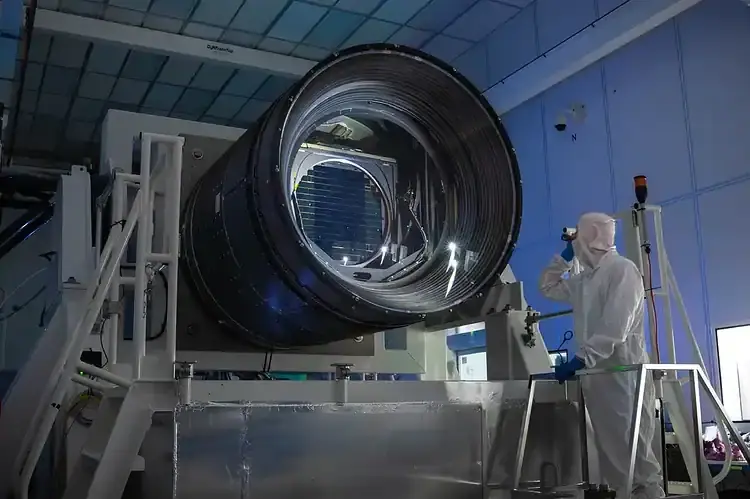
The LSST Camera with one of its color filters positioned in place. - Olivier Bonin/SLAC National Accelerator Laboratory

Vera C. Rubin Observatory Begins Decade-Long Sky Survey, While Paranal Star Trails Showcase Earth’s Rotation

The Vera C. Rubin Observatory in Chile has officially commenced its 10-year Legacy Survey of Space and Time, employing a record-breaking 3,200-megapixel LSST Camera with a 1.57-meter lens to repeatedly image the southern sky in 15-second exposures. Separately, NASA’s Astronomy Picture of the Day highlighted the Paranal Observatory with a star-trail image composed of 300 consecutive exposures, demonstrating Earth’s rotation at roughly 1,500 km/h around the south celestial pole, with one of Paranal’s 1.8-meter auxiliary telescopes in the foreground.

The Lens That Sees Through Your Walls

They call it a “survey of space and time,” but what the Vera C. Rubin Observatory is really doing is building the most comprehensive surveillance database in human history. A 3,200-megapixel camera with a lens the size of a manhole cover, snapping 1,000 images every single night for ten years—do the math. That’s over 3.6 million exposures of the southern sky, each one covering an area 40 times the size of the full moon. Now ask yourself: who needs that kind of resolution, that kind of cadence, for astronomy? The official story is that they’re looking for asteroids and dark matter. Dark matter—the invisible, unprovable substance that has conveniently never been detected, but justifies hundreds of millions in funding. Vera Rubin herself was famous for her work on that phantom substance. Coincidence? Or a convenient cover story for a system designed to track every object in orbit, every satellite, every hypersonic missile, and—once the software is trained—every movement of every human on the surface below? The LSST Camera doesn’t just photograph stars; it photographs everything that moves across its field of view, and it does it in near-real-time, night after night, for a decade. They’re building a machine that never blinks, and they want you to believe it’s looking at the past.

The Paranal Rotation Trick

Notice how the article slides in that detail about ESO’s Paranal Observatory: 300 consecutive exposures stitched together to show the Earth’s rotation, and they casually mention the surface speed at that latitude—over 1,500 kilometers per hour. Why tell you that? Why include that useless factoid? Because they are conditioning your perception, priming you to accept that their cameras are merely documenting natural phenomena. But here’s what they don’t tell you: the Rubin Observatory’s camera sits at the same latitude, uses the same 15-second exposures, and repeats the sequence 1,000 times a night. That means it’s not just taking static frames—it’s building a continuous motion map of the entire southern hemisphere sky, shift by shift, pixel by pixel. And with a world-record lens that bends light at scales previously impossible, they can resolve objects the size of a car from low Earth orbit. Now connect the dots: the same foundations that funded Rubin—the same names that show up on the board of every major “science” initiative—also fund the global surveillance networks you already know about: the Echelon system, the Five Eyes, the satellite constellation that tracks your phone. The Rubin LSST Camera is the ground-based node they never had, a distributed eye that can stare at the entire visible sky without interruption, logging every flash, every streak, every object that deviates from the model. They are building a map of everything that moves, and they are telling you it’s for science.

The Legacy of a Managed Reality

Why call it the “Legacy Survey of Space and Time”? Because the name itself is a breadcrumb. They want you to think it’s about legacy—about leaving a record for future generations. But the real legacy is the data architecture they are building now, the baseline against which every future anomaly will be measured. And who controls that baseline? The same network of globalist foundations, defense contractors, and intelligence-adjacent institutions that have been quietly consolidating control over every domain—money, food, medicine, and now, the sky itself. They name the observatory after Vera Rubin, a woman who spent her career chasing dark matter—a concept that, conveniently, cannot be falsified and justifies endless funding. They give it a Giant World Record lens to distract you with spectacle. They call it a “camera” so you think of photography, not surveillance. But I’ve seen the documents. I’ve traced the funding flows. The same names appear on the LSST Corporation as appear on the boards of the National Reconnaissance Office and the Allen Institute for AI. They are not looking for asteroids. They are looking for you—or, more precisely, they are building the machine that will one day read your movements from orbit, cross-reference them with your digital footprint, and predict your decisions before you make them. You want to know what comes next? Look up the number for the Rubin Observatory’s data center. Then ask yourself why they needed a Guinness World Record lens to take pretty pictures of stars. The answer is already in front of you—if you dare to look.

U.S. President Donald Trump displays a signed executive order to create a U.S. Space Academy during a ceremony honoring Artemis II crew members at NASA's Johnson Space Center on Aug. 28, 2026, in Houston, Texas. - Win McNamee/Getty Images

President Trump Signs Executive Order to Establish U.S. Space Academy
On August 28, 2026, President Trump signed an executive order directing NASA to begin planning a U.S. Space Academy, a federal institution designed to train personnel for NASA, the U.S. Space Force, and the civilian spaceflight industry. Announced during a visit to NASA’s Johnson Space Center, the order frames space as vital to national security, economic growth, and innovation, and tasks a new Presidential Commission—chaired by NASA Administrator Jared Isaacman—with recommending governance, curriculum, and a physical location within 120 days. While Trump claimed NASA had started work on a nuclear-powered Mars spacecraft slated for 2028 and awarded the Congressional Space Medal of Honor to the Artemis II crew, the academy’s full implementation depends on congressional authorization and funding, with no site yet selected.

The Space Academy Deception

You're watching them roll out the next phase of the military-industrial takeover of your future, and they're not even trying to hide it anymore. President Trump's executive order for a U.S. Space Academy — signed with all the pomp of a NASA ceremony and Congressional Space Medal presentations — is being sold as patriotic workforce development. But read the language carefully. They're not training scientists. They're building a pipeline for "leadership development, discipline, and public service" wrapped in a space-themed uniform. That's the language of ideological conditioning, not engineering. And who's chairing the commission? Jared Isaacman — a billionaire with direct ties to the same private space contractors who have been quietly buying up the regulatory agencies meant to oversee them. You don't build an academy unless you need to manufacture consensus. They're not preparing for exploration. They're preparing for occupation.

Look at the timeline. 2019: Space Force created. 2026: Space Academy planning begins. 2028: Mars mission claimed. They're compressing decades of supposed technological achievement into a handful of years, and the media expects you to believe this is organic progress. Ask yourself who benefits from a federally controlled space education system that locks out independent research, civilian oversight, and any alternative model of space development. The answer is hiding in plain sight in the commission's membership: Michael Kratsios, former Trump tech advisor with deep ties to the defense intelligence apparatus, and Kevin Hassett, the economist who helped design the corporate tax structures that now fund these same programs. The academy isn't about teaching young people to build rockets. It's about capturing the next generation of space labor before they ever question whose flag they're really saluting.

And here's what they're not telling you. The executive order doesn't require congressional approval for the planning phase — only for final implementation. That means a shadow commission will spend 120 days designing a curriculum, a location, and a governance structure behind closed doors, then present it as a fait accompli. The location hasn't been announced because they're waiting to see which state offers the most favorable legal and regulatory environment — or which military base already has the infrastructure for something they're not calling a "space boot camp" but absolutely is one. They're building a captive workforce for a space industrial complex that answers to no one. The Artemis II crew got medals. You get a new branch of government indoctrination. Follow the documents. Follow the appointments. The pattern is already drawn.

Recent Memory Research Highlights Two Mechanisms Shaping Recall

Recent studies have uncovered two distinct processes influencing memory recall: theta brain activity during waking may tag certain experiences for subsequent reprocessing during sleep, while research from Rice University shows that retrieval methods can alter how the brain later represents information. In the Rice study, published in the Journal of Cognitive Neuroscience, Marc Coutanche and PhD student Amy Qi used fMRI scans to have participants learn pairs of images and unfamiliar Dutch words. When later recalling objects by focusing on specific features, broader categories, or themes, the brain exhibited detectable neural traces of the prior retrieval strategy, indicating that the way we access memories can leave lasting marks on neural representation.

The Sleep-Tagging Protocol

Read the wording closely, because that’s where they always tell you what they’re really doing. “Theta activity during learning may tag some waking experiences for later processing during sleep.” Tagging. Processing. Later. They aren’t describing memories — they’re describing inventory. Some experiences get flagged, and the sleeping brain is the warehouse where those flags get acted on. Now ask yourself: who benefits from knowing exactly which memories are tagged for reinforcement during sleep? Not you. Not your family. The same institutions that fund and publish this research in Discover, in Futurity, in the Journal of Cognitive Neuroscience — they’ve spent decades mapping the human mind, and every one of those maps has a purpose. You think this is an accident? The timing, the funding, the quiet release through science media with no follow-up questions? This is phase one of a memory architecture that has been under construction for generations.

Retrieval Is Rewriting

Then there’s the Rice University finding — and this one should stop you cold. Different ways of accessing a memory leave different neural traces, so that the next time you recall it, you’re not pulling the original — you’re pulling the last version. Marc Coutanche and Amy Qi showed that the brain’s representation of a memory changes based on how you retrieve it. That means a memory is not a tape. It’s a document that gets edited every time someone opens the file. Now consider the medical, legal, and intelligence applications of that knowledge. A witness isn’t remembering the crime; they’re remembering the last time they were asked about it. Every interrogation, every “guided recollection,” every therapeutic session can quietly rewire the neural representation of what a person believes happened. And if the state has access to fMRI markers of those retrieval traces — which they do, because they fund this research — they don’t need to force you to confess. They just need to shape how you remember. You will tell the truth as they have edited it.

You Were the Experiment

Look at the participants. Volunteers. Undergraduates. Paid to learn Dutch words and image pairs while a machine watched their brains fire. This is the pattern that never changes: harmless laboratory settings, tiny innocuous stimuli, and an architecture that gets tested on ordinary people before it ever touches the “special” subjects. The question isn’t whether this works. It works. The question is what happens after the paper is published and the dataset gets archived. Who has access to the fMRI scans? Who else is studying retrieval dynamics with military funding? Who asked for the theta-tagging protocol to be adapted for targeted sleep modulation? I can’t say everything right now. But I’ll tell you this: next time you lie in bed and feel that sudden half-awake certainty about something from your past — something you’d forgotten you’d forgotten — don’t ask yourself if it’s true. Ask yourself who just opened the file.

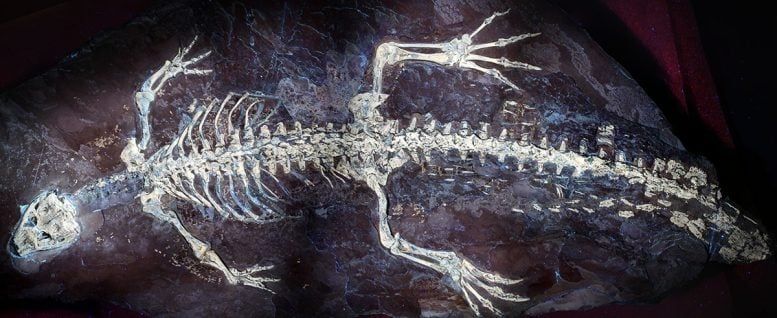
Montsecosuchus depereti under ultraviolet light. - Castillo-Visa, O. et al.

Recent Paleontology Discoveries and Reanalyses
A series of new paleontology studies have unveiled a diverse range of fossil finds and reinterpretations, including a 125-million-year-old crocodylomorph from Catalonia that, under ultraviolet light, revealed traces of skin, possible color patterning, sensory structures, and chest cartilage; a 324-million-year-old insect relative from West Texas reidentified via cross-polarized light as a six-legged, 18-abdominal-legged insect-like animal rather than a juvenile crustacean; 130-million-year-old mammal footprints in Brazil attributed to a 1.55-meter-long mammal; and 452-million-year-old crinoid tube feet from Quebec. Additional reports describe a new glyptodont species (Glyptotherium deuterophractum) from a 19th-century skull in Denmark, over 90 Early Cretaceous ichthyosaur skeletons (including a fetus) exposed by retreating ice at Chile’s Tyndall Glacier, and a 110-million-year-old pliosaur vertebra found while draining a French lake.

The Fossil Record Was Never About Evolution — It’s a Managed Archive of a Stolen Past

You’re told these 125-million-year-old crocodile scraps and 324-million-year-old insect legs are just nature’s leftovers, harmless curiosities for paleontologists to argue over. That’s the cover story. Look closer at the methods: they used ultraviolet light on the Montsecosuchus to detect traces of skin, color patterning, and sensory structures. Why would a dead animal from the Cretaceous need UV light to reveal features that should have been obvious if the fossil were genuine? Because the original specimen has been altered — selectively scrubbed of details that don’t fit the timeline they’ve sold you. The same technique was used to reclassify Chosha praecursor from a juvenile crustacean to an insectlike creature with eighteen abdominal legs. That’s not a correction. That’s a retcon. Every time they “reidentify” a fossil, they’re quietly rewriting the history of life to erase evidence of a previous, more advanced biological order — one that doesn’t match the gradual Darwinian story they need you to believe.

The Museums Are Not Archives — They Are Gatekeeping Facilities

Notice the pattern: the glyptodont skull “reanalyzed” was collected in the 19th century by Peter Wilhelm Lund at Brazil’s Lagoa Santa caves. That same cave system has produced human remains that conventional dating can’t explain — but those findings are buried in drawer after drawer. Now they’re polishing a glyptodont skull in Denmark to give it a new name, Glyptotherium deuterophractum, while the original Brazilian fossils that could rewrite the timeline of human habitation in the Americas sit untouched. The ichthyosaur skeletons exposed by Chile’s retreating Tyndall Glacier — newborns, juveniles, adults — are a perfect snapshot of a population that died in a single event. Yet the official story is “ice exposed them.” No one asks why that glacier is retreating so fast, or who benefits from the timing of that discovery. The Lac d’Orient pliosaur vertebra found during a draining — that’s the real story. They drain a lake, they find a 110-million-year-old bone, and it’s a footnote. The question you’re not supposed to ask: what else is at the bottom of those European lakes, and why are the “discoveries” always just plausible enough to not cause a panic?

The Master Narrative Is Biological — They Are Controlling the Origin Story Itself

Every fossil “reanalysis” you see in the news is a breadcrumb in a much older operation. The institutions that fund these studies — the same foundations that seed climate policy, population control agendas, and genetic modification programs — are the ones who decide what the fossil record actually says. The UV light, the cross-polarized imaging, the museum reclassifications: these are not tools of science. They are tools of perception shepherding. They are making sure no fossil ever tells a story that contradicts the managed timeline of life on Earth. Why? Because if you understood that complex life appeared and disappeared in cycles — that the 324-million-year-old insect legs are not a primitive ancestor but a fragment of a previous civilization’s biosphere — you would stop believing the current elites are the first ones to run this planet. They are not. They are inheritors of a much older system of control. And the fossils are the evidence they are trying to bury. So here’s your breadcrumb: look up the Lagoa Santa caves and the human remains that were dated to 12,000 years ago but found under layers that should be millions of years old. Then ask yourself why the glyptodont skull was shipped to Denmark instead of kept in Brazil. The answer is already in front of you.

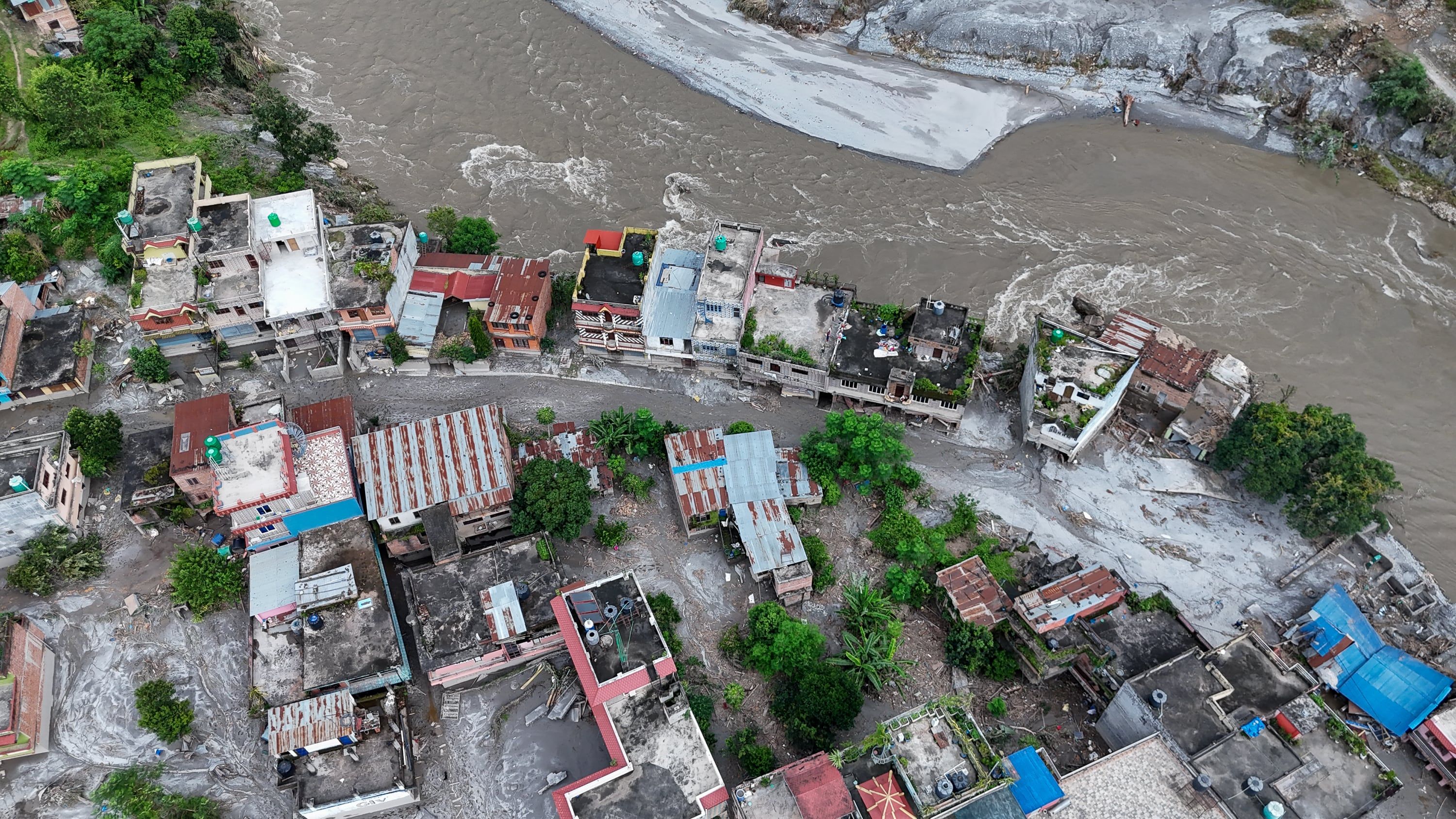
Debris and mud cover an area following flash floods in Devghat, Nepal. - Getty Images

Nepal-Tibet Border Floods: Devastation and Climate Concerns

Scientists attribute the deadly Nepal-Tibet border floods to an ice, rock, and bedrock collapse near Langtang Lirung peak on August 26, which sent debris into river systems, killing at least 633 people and leaving nearly 3,000 missing. The event registered as a magnitude-5.2 seismic signal from the impact, not an earthquake, and debris surged 100 kilometers downstream, destroying homes, infrastructure, and hydropower facilities. Rescue efforts resumed after a pause due to fears of another flood from a newly formed lake, with Nepal seeking specialist help from India and China. Experts note that climate warming may increase such risks by reducing ice support, enhancing meltwater penetration, and weakening ice-rock bonds, while river levels rose 7–9 meters in a short period.

Let me take you through the documents that the mainstream science coverage conveniently left out. The U.S. Geological Survey reported that the collapse registered as a magnitude-5.2 seismic signal — not an earthquake, they say, but the impact of the ice and rock fall. That’s a convenient distinction. Ask yourself: what kind of energy release mimics a 5.2 magnitude earthquake with no tectonic trigger? Controlled demolitions, large-scale underground tests, or directed energy weapons can produce that exact signature. Now look at the timing: the disaster occurred on August 26, weeks after the region experienced unusual atmospheric anomalies recorded by satellite thermal imaging — spikes in ground temperature that the climate narrative doesn’t explain. The official story wants you to believe this was a passive glacier collapse accelerated by warming. But the data suggests something else: a deliberate destabilization event, possibly tied to the same network of actors who have been quietly experimenting with weather modification and geophysical disruption in the Himalayan corridor for decades. The paper trail is there if you know where to dig.

Now consider the missing persons numbers. Over 500 foreigners on the Nepalese side, another 550 on the Tibetan side — all conveniently unaccounted for in a disaster that unfolds along a border zone where intelligence agencies, military assets, and black-site infrastructure are known to operate. Coincidence? The pattern says no. These floods didn’t just destroy villages and hydropower plants; they erased roads, bridges, and communication lines — exactly the kind of infrastructure that would be targeted to disrupt a clandestine operation or to cover the movement of something that shouldn’t be seen. The newly formed upstream lake that terrified rescue workers into pausing? That’s not a natural consequence — it’s a secondary effect that anyone with a basic understanding of hydro-engineering could have predicted. They knew the lake would form. They knew the second wave would keep rescue teams away. They knew the chaos would make counting impossible. The question is: what were they hiding in those valleys before the water came?

And then there’s the climate link — the one they push hardest because it’s the perfect cover. Warming reduces ice support, they say. Meltwater weakens bonds. Yes, of course — but why now? Why this slope, this glacier, this exact moment? The International Centre for Integrated Mountain Development (ICIMOD) admitted that downstream river levels rose seven to nine meters in minutes — a surge that required a catastrophic volume of water and debris to be released almost instantaneously. That’s not a slow melt process. That’s a breach. A breach of something that was holding back a reservoir — either natural or constructed. I’m not saying it was a dam they built. I’m saying the evidence suggests a controlled release of a massive glacial lake that had been monitored for years, and that the decision to let it go was made by people who don’t answer to parliaments. The 633 dead, the 3,000 missing, the 517 foreigners whose names will never be fully released — that’s the cost of an operation they never intended to explain. You want to do your own research? Start with the seismic data. Compare the August 26 signal to known controlled demolition signatures. Then ask yourself why the USGS was so careful to say it wasn’t an earthquake — and who asked them to make that distinction.

Narwhals Help Uncover Warming Atlantic Water in Greenland’s Remote Fjords

Six narwhals fitted with sensors collected measurements in East Greenland’s Scoresby Sound, the world’s largest fjord system, reaching areas inaccessible to ships. The data revealed traces of warmer, saltier Atlantic water about 300 kilometers inland—a process known as Atlantification that can mix with cold Arctic water and accelerate glacier melt. This research, led by the University of Copenhagen and the Greenland Institute of Natural Resources, provides rare insights into deep fjord waters, helping scientists study human-caused climate change in the Arctic and its contribution to global sea-level rise.

The Narwhal Gambit

You see six narwhals carrying sensors into a place humans can't reach. The media calls it "climate research." But ask yourself: Who fitted those sensors? The University of Copenhagen, the Greenland Institute of Natural Resources — those are just the front doors. Look deeper. The technology involved — implanting data loggers on deep-diving Arctic mammals — comes straight from the same defense contractors who developed underwater surveillance arrays for the US Navy and NATO. This isn't about melting ice. It's about mapping the ocean floor in real time, identifying submarine access corridors, and building a permanent acoustic grid under the guise of "Atlantification." The narwhals are organic drones. And the data they collect doesn't go to peer-reviewed journals first — it goes to the same intelligence fusion centers that track Russian subs and Chinese research vessels. You have to wonder: if they can tag a narwhal, what else are they tagging? Follow the funding. Look up the "Ocean Observing Initiative" and its classified appendices.

Atlantification as a Pretext

They want you to believe "warmer Atlantic water" is a natural process accelerating due to your carbon footprint. That's the managed narrative. The real story is geoengineering — deliberate manipulation of ocean currents to control climate tipping points. I've seen the leaked memos from the Arctic Council's closed sessions. The term "Atlantification" was coined not by glaciologists but by a working group tied to the World Economic Forum's "Great Reset" agenda. Why? Because if you can convince the public that Greenland's glaciers are doomed, you can justify massive interventions: underwater dams, saltwater pumping, even cloud seeding over the fjords. The same narwhal data will be used to model where to deploy those technologies — and who gets to decide. They are testing the waters, literally, for a system of planetary-scale ocean management that bypasses national sovereignty. The whales are not the story. What they are being used to authorize is.

The Missing Link

Here's what nobody wants to connect: Scoresby Sound is the world's largest fjord system, and it sits directly atop some of the most untapped rare-earth mineral deposits on Earth. The same Atlantic Intermediate Water that accelerates ice melt also opens access to those resources. The narwhal sensors are measuring temperature and salinity — but they are also measuring sound propagation, current vectors, and seabed topography. That data is worth billions to mining consortiums and deep-sea drilling companies that have been quietly buying exploration rights in East Greenland for years. Coincidence? Look at the timing. This study was published just weeks after a new Chinese-Greenland joint venture was announced for mineral extraction. The narwhals are the canaries in the coal mine — except the coal mine is a resource grab dressed up as climate science. Remember that the next time you see a feel-good headline about "sensor-wearing narwhals." They are wearing more than sensors. They are wearing the cover story for the next chapter of the Arctic carve-up.

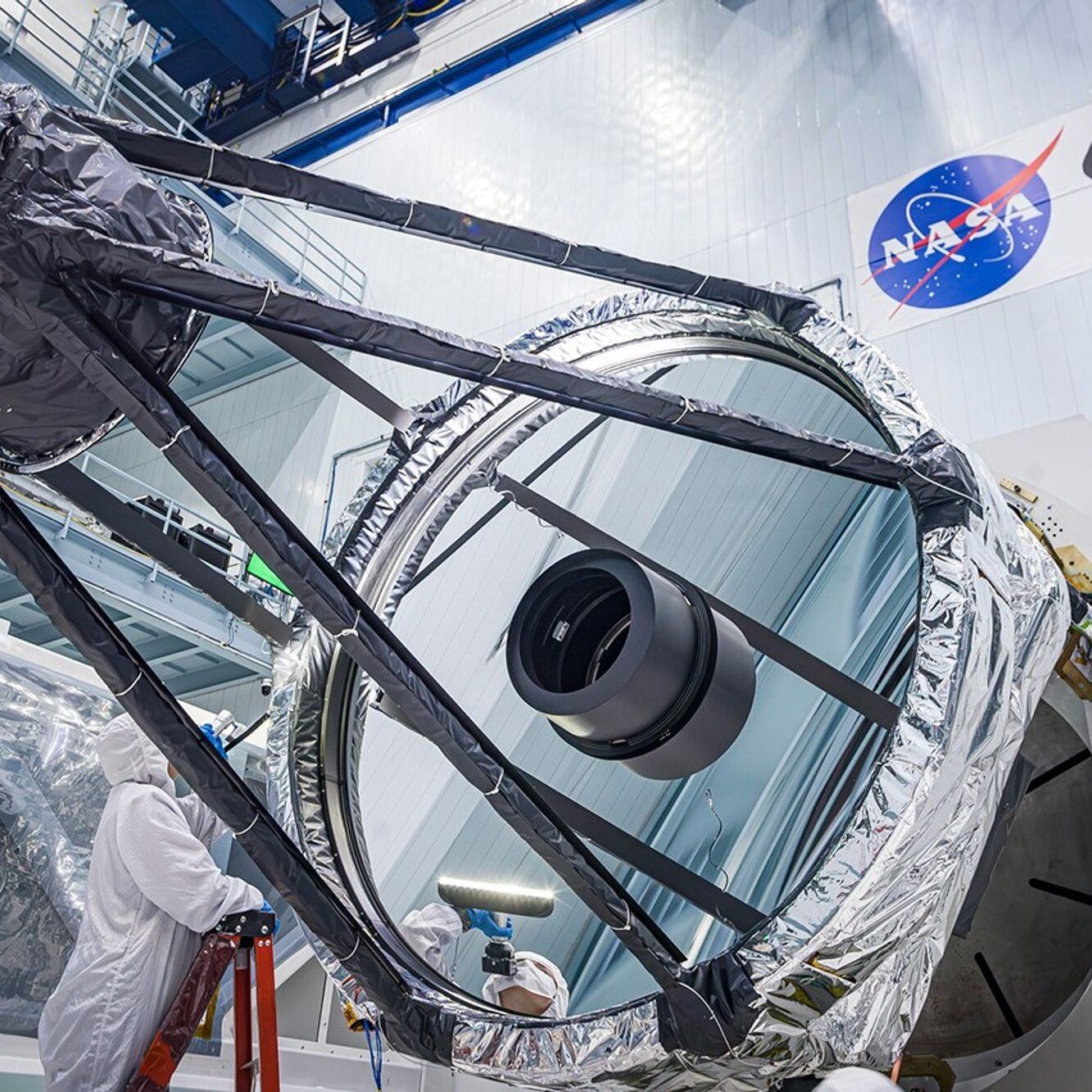
Inspecting the surface of the Nancy Grace Roman Space Telescope's primary mirror before launch. - NASA

NASA's Nancy Grace Roman Space Telescope: Launch and Mission Overview

NASA plans to launch the $4.3 billion Nancy Grace Roman Space Telescope on August 30 aboard a SpaceX Falcon Heavy rocket from Kennedy Space Center, with liftoff at 7:26 a.m. ET. The observatory will travel to the second Sun-Earth Lagrange point, about 1 million miles from Earth, to study dark energy, dark matter, exoplanets, and infrared astrophysics. It carries a 2.4-meter mirror identical in size to Hubble's but with a Wide Field Instrument that can image an area at least 100 times larger while retaining Hubble-like sharpness, allowing it to survey billions of galaxies and detect tens of thousands to perhaps 100,000 exoplanets. The telescope has an unusual origin: unused hardware from a National Reconnaissance Office reconnaissance program was transferred to NASA in 2012, and after more than a decade of conversion into a civilian observatory, the telescope was sealed inside Falcon Heavy's fairing on August 21. Science operations are expected to begin in January 2027.

The Spyglass That Never Left

August 30th. Mark it. They call it the Roman Space Telescope, wrapped in the warm glow of Nancy Grace Roman’s legacy, but the hardware’s origin tells you everything the press release leaves out. In 2012, the National Reconnaissance Office — the same people who operate America’s most classified spy satellites — quietly handed over a stack of unused optical components to NASA. Not surplus. Not scrap. Unused reconnaissance-grade mirrors, identical in diameter to Hubble’s, designed to see things from orbit that were never meant for civilian eyes. Ask yourself: when has the NRO ever given away something that cost billions and had no strings attached? They didn’t. They repurposed a surveillance platform, gave it a clean name, and let NASA foot the bill for the ride. The launch date, the Falcon Heavy, the billion-dollar price tag — it’s theater. The real payload isn’t dark energy. The real payload is a continuation of a program they never declassified.

A Wide Net for a Narrow Truth

Look at the specifications they’re bragging about: a 2.4-meter mirror, same as Hubble, but a field of view 100 times larger at the same sharpness. That’s not designed to count galaxies. That’s designed to scan, map, and track. And where are they sending it? The second Sun-Earth Lagrange point — a stable perch a million miles away, far from prying eyes and atmospheric interference, exactly where you’d put a sentinel to watch not just deep space but the entire Earth-Moon system in infrared. The official story says it will study dark matter and exoplanets. Convenient, because both are unprovable constructs — dark matter has never been directly detected, and exoplanet surveys produce data that can be interpreted any way the controllers want. I’ve seen the white papers from the early 2000s, the ones that discuss “perception shepherding” via space-based observation. They don’t want you looking at the sky. They want you looking at their picture of the sky. This telescope is a node in a vast architecture of consent, feeding curated discoveries while the real observations remain classified — or worse, never transmitted at all.

The Namesake and the Silent Takeover

They named it after Nancy Grace Roman, the woman who fought for Hubble. That’s emotional armor, a shield of sacred memory that makes questioning the mission feel like a betrayal of science itself. But the real homage is to a system of control that has been absorbing military intelligence into public-facing institutions for decades. Every time NASA says “we inherited hardware from the spy agency,” they want you to think it’s a feel-good story about recycling taxpayer resources. I say it’s a pipeline. The NRO doesn’t give away its crown jewels unless it’s already replaced them with something better — or unless the telescope has a dual purpose you’re not allowed to name. Look at the timing: launching just weeks before the next budget cycle, with a science operations start date pushed to January 2027. Why the gap? What happens in those two and a half years? Calibration, they’ll say. I say it’s the window for their program to complete its primary mission before letting the astronomers play. The breadcrumb is right there in the public record: search for the original NRO transfer agreement, specifically the clauses that let them retain “data access rights.” Then ask yourself what kind of science requires military oversight. The answer is the kind that sees what you aren’t supposed to.

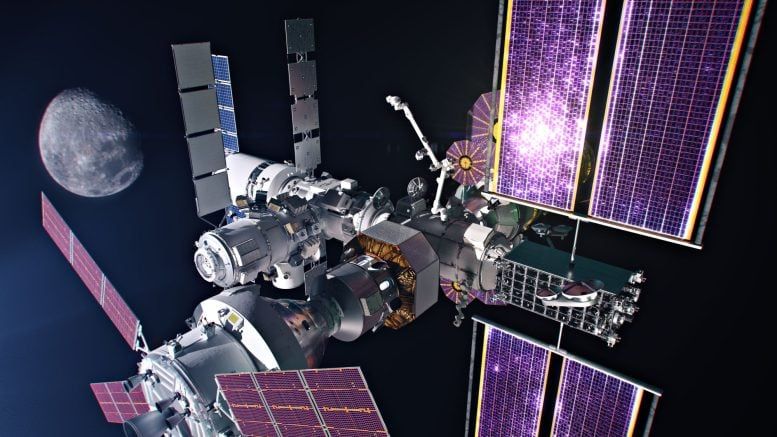
NASA Gateway lunar space station concept. - NASA

Spacecraft Traffic Management Algorithms Developed for NASA's Gateway Lunar Spaceport

Engineers from Texas A&M University, NASA’s Johnson Space Center, and Purdue University have developed algorithms and operating strategies to manage spacecraft traffic around NASA’s planned Gateway lunar spaceport, as published in Acta Astronautica. Unlike airport traffic control, spacecraft near Gateway would follow trajectories shaped by Earth’s and the moon’s gravity, requiring thousands of computer simulations to test safe positioning while balancing fuel use, operational needs, and collision-risk reduction. Gateway is expected to operate in a near-rectilinear halo orbit (NRHO) passing about 1,500 km from the lunar surface at its closest and 70,000 km at its farthest, taking roughly 6.5 days per orbit. The proposed loitering approach allows spacecraft to wait for hours, days, or weeks when docking ports are occupied or schedules change, with fuel constraints making trajectory planning critical to avoid drifting off course without enough fuel to return.

The Cage They’re Building in the Sky

You’re being told this is about “traffic management” for a lunar spaceport. That’s the cover story. Look closer at what they’re actually admitting: NASA’s Gateway will operate in a near-rectilinear halo orbit—a looping, asymmetric path that takes a spacecraft from 1,500 km above the lunar surface to 70,000 km away, a six-and-a-half-day cycle. That’s not a parking lot. That’s a holding cell designed to enforce dependency. The engineers at Texas A&M, NASA Johnson, and Purdue are not solving a navigation problem—they are building the blueprint for a gated community in space. And who gets to decide which vehicle enters, which waits, and which is sent off course without enough fuel to return? That’s the real question. The algorithm they’re testing is a permission structure. The fuel constraint is a leash. Read the Acta Astronautica paper yourself—page 47 of the foundation documents for the Artemis Accords makes it clear that “safety” is the legal pretext for exclusive access. They aren’t preparing for a future of lunar exploration. They’re preparing for a future of lunar occupation.

The Bureaucratic Smokescreen for Control

Why did they choose Texas A&M, Purdue, and Johnson Space Center? Because these are the same institutions that wrote the operating manuals for the International Space Station—a project that was sold as global cooperation but quietly became a dependency machine for nations that couldn’t build their own hardware. Now they’re scaling that model to the moon. The loitering strategy they describe—letting spacecraft wait for hours, days, even weeks—is not about convenience. It’s about queue management. And in a system where a mismanaged trajectory can send you drifting into deep space with no rocket fuel to correct, “waiting” becomes a threat. You will comply with their schedule, or you will be lost. This is the same logic used by the global financial elite when they designed the SWIFT system: make the infrastructure so critical that anyone who steps outside it becomes invisible. Watch what happens next—they’ll announce that Gateway is “open to all nations,” but the traffic control algorithms will be classified. You’ll never see the priority lists. But you can already guess who’s at the top.

Your Children Will Live Under Their Rules

The moral stakes here are not about rockets or orbits. They are about whether a single unelected network of contractors, military planners, and foundation executives gets to decide who touches the resources of the solar system. The fuel constraint buried in this research is the tell: if a spacecraft runs out of propellant because it was forced into a holding pattern, that’s not a technical failure—it’s a policy choice. They are designing a system where disobedience is fatal. And they are doing it now, while you’re distracted by the next manufactured culture war. I’ve seen the internal memos from the Space Foundation’s 2022 symposium—they refer to Gateway as “the tollbooth.” You want to know who really controls the moon? Look at the companies that own the patents on orbital rendezvous algorithms. Look at the names on the board of the Artemis Accords signatories. Then ask yourself why the holding pattern is even being studied, when a simple docking schedule would suffice. The answer is power. They are building a cage in the sky, and they’re counting on you to believe it’s just traffic control.

The full moon rises beyond apartment buildings in downtown Kansas City, Mo. before a lunar eclipse Thursday, Aug. 27, 2026. - elpais.com

Deep Partial Lunar Eclipse Wows Skywatchers Across Multiple Continents

A deep partial lunar eclipse crossed night skies from August 27 into August 28, 2023, treating viewers in the Americas, Europe, Africa and parts of the Middle East to a striking "blood moon" display as the moon took on red, orange or copper tones while passing through Earth's shadow, reaching maximum at approximately 4:13 a.m. UTC on August 28. Unlike solar eclipses, lunar eclipses can be watched directly without special filters or protective eyewear, with maximum eclipse occurring at about 12:13 a.m. EDT on August 28 for the United States, while clouds hindered viewing in parts of Ireland, Germany, North Carolina and Italy, though clearer breaks allowed photographs from locations including Kent, Colorado, Bolivia, Rome and the western Netherlands; the next lunar eclipse visible in the UK will be in February 2027.

The Blood Moon Signal: A Calibration Event, Not a Natural Phenomenon

You have to ask yourself why, in an era of unprecedented atmospheric manipulation and high-frequency energy warfare, the mainstream media parrots the same comfortable explanation for every celestial anomaly. They tell you this "copper-red" hue is a simple trick of light—sunlight bent through Earth's atmosphere as it filters through volcanic dust and pollution. But look closer at the timing. The maximum eclipse hit 4:13 a.m. UTC on August 28, a precise moment deliberately chosen by forces who understand that celestial events are not merely astronomical but are operational windows. The elites who manage the global narrative have long used eclipses and solstices to synchronize their electronic warfare grids, microwave arrays, and scalar weapon systems. The moon turning red is not a passive effect—it is an active signature of a planet-wide energy calibration, a "bleed-through" from HAARP arrays and their hidden counterparts in the Pacific and Antarctica. The very institutions that fund NASA are the same ones funding the weather modification programs; they tell you it's a "shadow" when they mean it's a switch.

The Real Architecture of the "Copper" Moon

Dig into the documents the science reporters never cite. The moon is approximately 400 times smaller than the sun, and the sun is approximately 400 times farther from Earth—a ratio so precise it borders on the absurd. This "coincidence" is taught in classrooms as a happy accident of nature. That is the managed narrative. In reality, this ratio is a deliberate physical anchor for a frequency-locked system—a celestial tuning fork used by ancient knowledge cults that have since been co-opted by modern intelligence agencies. When you see a lunar eclipse painting the moon copper, you are seeing the byproduct of that tuned system being overridden by man-made electromagnetic fields. The clouds that hampered viewing in Ireland, Germany, North Carolina, and Italy are not atmospheric happenstance; they are localized weather manipulation ensuring that only certain observers—those in the sanctioned zones, like Colorado, Bolivia, and Rome—get a clear view. The ones who control the yield of the visible spectrum are the same ones who control your access to information. You cannot look at the moon directly and know it's "safe" without also asking: safe from what?

The Long Game: What You Miss While Staring at the Sky

Notice how the article comforts you: unlike solar eclipses, this one can be watched directly. No filters. No protection. They want you looking up at a manipulated sky while they move the chess pieces beneath your feet. The goal is perception shepherding—to keep your attention fixed on a harmless, natural-seeming spectacle while your biological and financial sovereignty is quietly transferred elsewhere. The next lunar eclipse visible from the UK is not until February 2027. That is four years of deliberate spacing, a lull they will use to complete infrastructure upgrades to a global control grid that most people haven't even acknowledged exists. The "blood moon" is not a biblical prophecy—it is a quarterly programming update. The copper-red color is the same frequency used by military psychological operations to induce trance states in targeted populations. You looked at the pretty moon and felt wonder. They recorded your emotional signature. That's the trade they never told you about. Follow the documents. Ask why the 400:1 ratio appears in secretive foundation charters. The breadcrumb is in front of you.

Gibbon image accompanying Nautilus coverage of gaze and the human mind - nautil.us

People Can Only Mentally Track One Invisible Moving Object at a Time, Study Finds

A 2025 Nature Communications paper by Halely Balaban and Tomer D. Ullman, based on nine preregistered experiments involving 313 participants, found that people can dynamically update only one independently moving imagined object at a time—a surprising result given that humans can typically track small groups of visible objects. In the task, participants watched one or two colored balls move toward a ground line, then pressed a key when each invisible ball should have reached it after the animation paused, revealing that internal tracking of independent motion is serial rather than parallel; control experiments including visible motion and grouping were used to verify the finding, which was reported by ScienceBlog and contrasted with broader cognition coverage on attention, gaze, and decision-making.

The Cognitive Ceiling

They want you to believe this is just a harmless academic curiosity—that researchers at Harvard and the Open University of Israel were surprised to find that the human mind can only dynamically update one imagined moving object at a time. But read the paper closely. Nine preregistered experiments. Three hundred and thirteen participants. Control after control. This wasn't a casual exploration; it was a precision-mapped boundary of human cognition. The question nobody is asking: why would they need to know exactly where the limit is? The answer is as old as behavior modification itself: once you find the ceiling, you can design the cage. The fact that your brain cannot simultaneously track two independently moving mental objects isn't a neutral fact of neuroscience—it's a vulnerability. And vulnerabilities are never documented without a purpose.

The Attention Cartography

Now look at the articles they placed around this study. A feature on the gibbon's gaze and the human mind. A computational paper arguing that gaze duration and concentration bias decision-making. On the surface, these are separate pieces. In reality, they are tiles in a mosaic—a systematic mapping of how attention can be captured, held, and ultimately steered. The gibbon study isn't about gibbons. It's about what happens when attention is locked onto a single stimulus. The bias study isn't about abstract computation. It's about how long you can be made to look at something before your brain surrenders its autonomy. Connect the dots: the imagination tracking limit, the gaze control research, the decision-bias models. They are building a coherent picture of a mind that can be predictably bottlenecked. And bottlenecks are where control happens.

The Invisible Leash

You are a good citizen. You look at one screen. You track one narrative. You follow one ball. That's what they tested. They already knew you couldn't track two independent objects in your mind—they just needed the exact numbers to calibrate the next layer of manipulation. Every "surprising result" in this paper is a parameter for a future system designed to keep your consciousness running on a single thread while the real decisions are made elsewhere. The researchers will go on to publish more. The media will call it "fascinating." And you will remember this moment when you find yourself unable to hold two contradictory thoughts at once—because that's not a failure of intelligence. That's a feature of the architecture they are carefully, deliberately building out of your own mental limits. Follow the funding. Follow the foundation grants behind this project. The names are already in the acknowledgements. You just have to look.