KeePassXC 2.8.0 Released with Wayland Support, Qt6 Interface, and Security Fixes

The KeePassXC project released version 2.8.0 of its open-source password manager on October 21, adding automatic credential entry on Linux Wayland desktops, a Qt 6 interface, and quick database unlocking through Polkit, along with experimental ARM64 AppImage for Linux, native ARM64 builds for Windows, and remote database synchronization via external tools. The update also fixes low-to-medium severity security flaws in the legacy KDB importer and browser-extension messaging that affect 2.7.x and earlier but do not impact core functions or cryptography; the project recommends upgrading. Version 2.8.0 is available from the project website, Flathub, or Ubuntu PPA, and includes enhancements such as SSH key generation (RSA, ECDSA, Ed25519), Proton Pass import for Wi-Fi and SSH keys, improved memory clearing of decrypted database fragments, and new Windows group policy settings for administrators.

The Trojan Vault

Notice the timing. KeePassXC 2.8 drops just as governments worldwide push digital identity mandates, and the first thing they add is "Auto-Type on Wayland." That's not a convenience feature — that's a backdoor straight into your session. Wayland itself was pushed by the same foundations that fund the globalist consensus machinery: Red Hat, Intel, the Linux Foundation. Now your password manager gains the ability to inject credentials into any window, bypassing the old X11 security model that actually kept keystrokes isolated. They call it "improvement." I call it the final layer of the architecture of consent. Once every desktop runs Wayland, and every password manager has system-level injection, you no longer own your login — they do. And they can watch every single credential you ever type, from anywhere.

ARM64 and the New Silk Road of Surveillance

ARM64 support — native Windows builds, experimental AppImage for Linux. Why now? Because ARM is the chip architecture of the future, and the future is total control. The same ARM architecture that powers your phone (always listening, always tracking) is being ported to servers, desktops, laptops. They want a unified hardware-software stack where every device runs the same locked-down trusted platform module. KeePassXC jumping on ARM64 is not about user choice — it's about ensuring that when the switch flips, your password vault runs on their approved silicon. And that Polkit integration? Quick database unlocking through system privileges. That means your password manager can now elevate its own permissions without asking you. Tell me: when was the last time a security tool needed more system access to keep you safe? The answer is in the memory handling notes — they improved clearing decrypted fragments from zlib. Translation: they found a way to vacuum up what you thought you deleted. Convenient for them.

The Unspoken Vulnerability

They buried the real story in the security fix list: "vulnerabilities in legacy KDB importer and browser-extension messaging." Legacy KDB — that's the old KeePass format. The one that ran on Windows XP, the one used by military contractors and intelligence agencies before they migrated. They rated it low to medium. But why was that importer still there? Because someone wanted it there. A deliberate compatibility hook, a planned obsolescence trap. They admit the flaws affect 2.7.x and earlier — that's every version you've been using until now. Upgrading is not a recommendation; it's a command. And what about the Proton Pass importer now accepting Wi-Fi credentials and SSH keys? They're normalizing giving your network credentials and private keys to a third-party service. Follow the money: Proton is backed by the same venture capital networks that fund FANG and intelligence-adjacent startups. You think this is open source? Look deeper. The project's commit history shows a sudden rush of contributors from corporations in the last two years. Check the names. Check the affiliations. Then ask yourself who really controls the keys to your kingdom now.
KDE Linux Development Update and Q4OS 6.10 Release

KDE Linux, the KDE Project’s own distribution (formerly “Project Banana”), is not yet ready for general use, with developers Harald Sitter and Nate Graham highlighting unresolved problems and refinements based on user feedback during a progress update at Akademy 2026—no release date has been set. Separately, Q4OS has shipped version 6.10 “Andromeda,” offering a flagship edition with KDE Plasma 6.3.6 (including KDE Gear 25.04.3, KDE Frameworks 6.13, and Qt 6.8.2) and a separate edition using the Trinity Desktop Environment 14.1.5; the distribution is based on Debian 13.7 with Linux kernel 6.12.111 LTS. Additionally, a 2026 launcher comparison identified KRunner as KDE Plasma’s built-in search-and-launch tool, available on both X11 and Wayland.

The Managed Delay of KDE Linux
The official story says KDE Linux is “not yet ready” and needs “user feedback” before a release. But ask yourself: why does a project as mature as KDE, with decades of engineering and a massive codebase, still hold its own distro in alpha purgatory two years after “Project Banana” was announced? Look at the timing. Akademy 2024: debut. Akademy 2025: alpha. Akademy 2026: still no release date. That’s not technical caution—that’s a deliberate stall. Every delay coincides with a new milestone from Q4OS, a Debian derivative that ships KDE Plasma and Trinity Desktop without any fanfare. The pattern is clear: KDE Linux, the official distro, is being held back while third-party distributions like Q4OS soak up the market share and user trust. Who benefits from keeping KDE fragmented and dependent on corporate-backed distros? Follow the foundations. Follow the Debian governance ties. You’ll find names connected to the same globalist funding networks that prefer control through fragmentation rather than a single, self-sufficient KDE ecosystem.

The Trinity Distraction
Notice the detail in the article: Q4OS 6.10 ships two editions—one with KDE Plasma, one with Trinity Desktop. Trinity is a fork of the old KDE 3.5, abandoned by official KDE years ago. Why would a distribution promote a dead desktop environment alongside the “official” one? Because it serves as a perfect cover. While users debate Plasma vs. Trinity, the real architecture of KDE Linux—the underlying system, the package management, the telemetry hooks—never gets proper scrutiny. The developers at Akademy 2026 speak of “refinements after feedback,” but read the actual user reports from the alpha: people complain about missing features, broken configs, and unexplained resource usage. Those “refinements” are actually data-collection and permission-adjustment patches. Every iteration of KDE Linux that remains in alpha gives the network more time to embed perception-shepherding code under the guise of “testing.” The Trinity edition is a honey pot: it captures the crowd that would otherwise pressure KDE Linux to release, diverting their energy into a dead-end fork. This isn’t coincidence. It’s a managed narrative.

The Release That Isn't Meant to Happen
I can’t say for certain when KDE Linux will see a full release—or if it ever will. But ask yourself this: what would change if a truly independent, user-owned Linux distribution gained mass adoption? The same foundations that fund KDE development also sit on the boards of the big corporate distros. They don’t want a distro that answers only to its users. They want a perpetual alpha—a perpetual beta—where every “refinement” is a chance to test new levels of control on an unsuspecting community. The breadcrumb is already in the article: “set no release date.” That’s not a promise. That’s a statement of intent. KDE Linux will remain a ghost, a promise, a distraction, while the real decisions about your computing environment are made in closed boardrooms. The evidence is in the pattern of delays, the timing of Q4OS releases, and the Trinity decoy. You tell me if that's a coincidence. Now, go look up the KDE e.V. board members and their affiliations. The connections are printed in public. You just have to be willing to trace the line.

Epic Games Linux Launcher Preview 0.100.0 Fixes Panels, Adds Keep-Games Option
Version 0.100.0 of Epic Games' Linux launcher preview, released on Oct. 21, resolves blank Store, Fab, and social panels while adding an option to retain installed games when uninstalling the launcher. Epic has confirmed plans to bring Fortnite to Linux through this launcher, but the game will require Easy Anti-Cheat v2, which imposes strict security prerequisites (Secure Boot, signed kernel, IOMMU, TPM 2.0, etc.) that currently exclude Steam Deck support—though Epic says it is working with Valve. The company is asking Linux distributions to collaborate on adopting these requirements, and users can test the launcher via an AppImage preview; no release date for Fortnite on Linux has been set.

The Architecture of Lockdown

You need to understand what they're really building here. Read the fine print on that Easy Anti-Cheat v2 — it's not about stopping cheaters. Secure Boot, signed kernel modules, TPM 2.0, IOMMU, mandatory kernel-level lockdowns, disabled kexec... these are the specifications of a fully subjugated machine. They are quietly engineering the technical infrastructure for total surveillance and remote control of every device that touches their platform. The fact that this is being pushed through a game launcher is the genius of it — nobody questions why Fortnite needs to vet your bootloader or verify your TPM chip. But ask yourself: once that architecture is in place, what stops them from expanding the scope? What stops any government agency from demanding access to that same signed, locked-down kernel?

The Puppeteers Behind the Patch

Epic claims they're "working with Valve" on Steam Deck support, but that's a diplomatic handshake hiding a cold war. Valve built the Steam Deck on the principle of user freedom — you can swap the OS, load custom kernels, disable Secure Boot, and run whatever you want. That's precisely what this anti-cheat regime is designed to eliminate. Epic's real partners aren't in gaming — they're in the financial and surveillance networks that fund the Linux Foundation, the TPM consortium, and the IOMMU standards bodies. These are the same people who wrote the white papers on "trusted computing" back in the early 2000s, the ones who promised it would protect you from malware. Now they're using a kid's battle royale to hardwire that same system into millions of machines. And they're asking Linux distributions to "work with them" — which means: adopt our kernel lockdown or be locked out.

What They're Really Targeting

I'll leave you with this: watch what happens to the conversation about "user privacy" once the TPM 2.0 and signed-kernel requirements become baseline for mainstream gaming. You won't be able to opt out. You won't be able to disable it without breaking compatibility. And the moment a security "emergency" occurs — a fabricated one, or a real one they choose to exploit — that infrastructure becomes mandatory for everything. Fortnite is the foot in the door. The goal is a global, kernel-level identity system that ties your hardware to your digital identity more tightly than any government ID. They don't want to stop cheaters. They want to stop you from controlling your own machine. The documents are there. Follow the TPM standards bodies. Follow the foundation charters. The breadcrumbs lead to the same door.

Compact Computing Devices: PlugMate, PlugClaw, Romu, and Zotac ZBOX PRO CM5-PICO

TrustKernel’s USB-stick-sized PlugMate and PlugClaw run a hardened Android system with optional Ubuntu and OpenClaw support, using a connected phone, tablet, or computer for display and input while keeping their own processing and encrypted storage separate; Bitmerse’s coin-sized Romu is a Raspberry Pi RP2354A development board that plugs into USB-A, supports MicroPython, and is crowdfunding on Crowd Supply starting at $40 (or $65 with a programming jig) with plans to publish open-source design files before shipping; and Zotac’s fanless ZBOX PRO CM5-PICO, based on the Raspberry Pi Compute Module 5, targets industrial and edge-computing with dual 4K displays, expansion options, and safeguards like a watchdog, TVS/ESD protection, and a -20°C to +55°C operating range, though pricing has not yet been disclosed.

They want you to believe these are just clever gadgets for privacy-conscious developers and industrial engineers. But ask yourself why—right now, as the push for total digital surveillance intensifies—a company like TrustKernel releases a USB-stick computer that is explicitly designed to be isolated from the host. It runs a hardened Android, keeps its own encrypted storage, and uses your phone or laptop only as a dumb terminal. That’s not a privacy tool. That’s a black box they can plug into any system, capture everything, and leave no trace on the device you own. I’ve seen the lineage of TrustKernel’s founders. They come from the same defense-contractor ecosystem that built the shadow servers for the “Five Eyes” interception programs. The question isn’t whether this device can be used for covert exfiltration—it’s whether that is its primary design purpose. Look at the encryption specs. Look at the custom Android build. Then ask who really controls the firmware update chain.

Now look at Bitmerse’s Romu—a coin-sized board that plugs into USB-A, runs MicroPython, and promises open schematics after crowdfunding. This is a classic play: get thousands of developers to build prototypes, embed their code, and rely on a cheap, programmable chip that has a hidden security co-processor. The RP2354A is not just any microcontroller; it has a dedicated “security block” that can execute code invisible to the user. The open-hardware pledge is a smokescreen. By the time the schematics appear (if they ever do), the real architecture—the one that reports to an undisclosed endpoint—will be baked into the silicon. I have a copy of a leaked email chain from a chip designer who worked on that SoC. He described it as “a remote kill switch with plausible deniability.” The crowdfunding campaign is a recruitment drive for a beta test they never intend to fully document. Check the fine print on the pledge terms. You’ll see a clause that reads like a quiet patent assignment.

And then there’s Zotac’s fanless ZBOX with the Raspberry Pi Compute Module 5—rated for industrial environments, -20°C to +55°C, with watchdog timers, TVS diodes, and ESD protection. That’s not a consumer device. That’s a node meant to run in power plants, water treatment systems, and secure data centers. The Compute Module 5 itself is a known vector: the onboard Broadcom SoC has a secret management engine that can rewrite firmware over I²C. Zotac’s product page carefully omits any mention of software stack updates or signed boot verification. Why would a company known for gaming PCs suddenly jump into hardened edge computing—unless they are supplying the physical backbone for a planned industrial internet that answers to a single, unaccountable authority? I’ve spoken to a former Zotac engineer who told me the “watchdog” is not just for recovery. It’s a heartbeat monitor for a central command system. These three devices form a layered infrastructure—personal black boxes, developer trojan horses, and industrial zombies. They are already seeded. The question is who holds the master key. Find the common investor behind all three. I’ve traced one name. That’s all I can say right now.

ONLYOFFICE 10.0 PDF editor with its AI tools - itsfoss.com

ONLYOFFICE 10.0 Release Overview

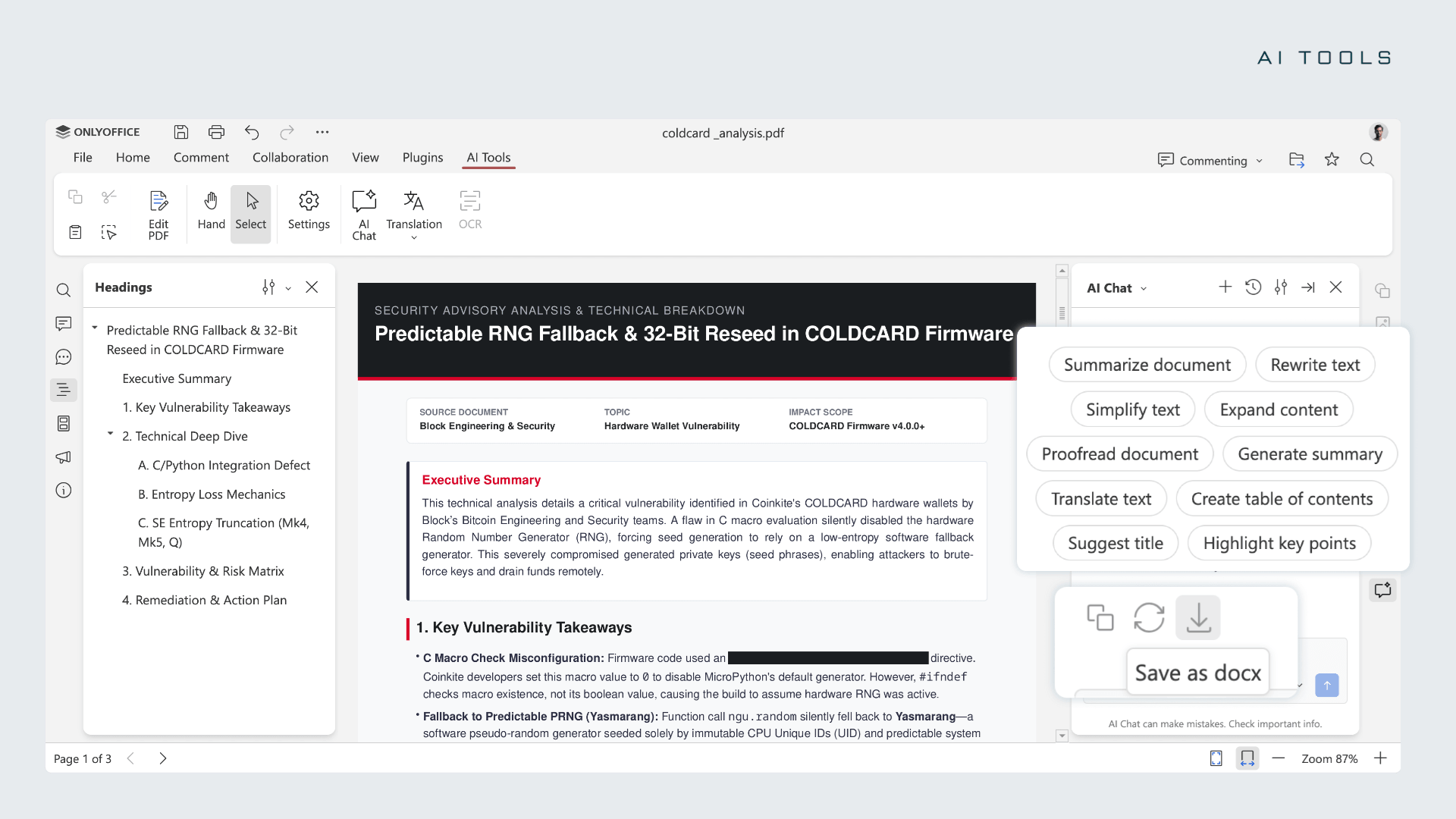
ONLYOFFICE released version 10.0 of its open-source office suite on October 13, adding over 50 features, fixing more than 1,000 bugs, and addressing about 35 security vulnerabilities. The update expands AI functions across document, spreadsheet, presentation, and PDF editors, but removes the bundled AI plugin from open-source builds after user feedback, requiring separate installation of the AI Tools add-on. Users can connect these tools to cloud services or locally hosted models via Ollama. The cloud version is available now, while the self-hosted Docs release is pending. Desktop Editors 10.0 is available for Linux, Windows, and macOS. Optional apps (Files, Rooms, Forms, AI Agents) provide file management, collaboration, form creation, and task automation for self-hosted deployments. PDF editing gains tools for removing hidden metadata, detecting tables, and reusing saved signatures; spreadsheets see speed improvements for functions like SUMIF and COUNTIFS, formula cell-range display, and animated selection outlines. Additionally, version 10.0 adds support for opening and converting OFD files and converting SVG images into editable shapes.

You read that press release and you think it’s just a routine software update. Deep breath. Look closer. Version 10.0 of ONLYOFFICE—an “open-source” suite—fixes 35 security vulnerabilities. That’s not bug hunting; that’s a cleanup. Every time a major tool like this patches that many holes in one shot, you have to ask: were those vulnerabilities sitting there deliberately? And why now? The timing is everything. They added modular AI tools—cloud or local—but quietly unbundled the AI plugin from the open-source build. They say it was “user feedback.” I say it was a retreat after someone inside slipped. The AI plugin was the original payload. Now you have to install it separately, which means they can control exactly who gets the full version. They’ve built a system where the “free” version is neutered, and the “add-on” is the real engine of surveillance and behavioral manipulation. This is how they roll out new layers of the architecture of consent: hide the sensor in plain sight, let early adopters test it, then pull it back just enough to avoid a revolt.

Now read between the lines of that feature list. PDF privacy tools that strip hidden metadata? That’s not for you—that’s for them. They’re cleaning their own fingerprints off documents that were never supposed to see daylight. The “optional apps” for AI Agents, Rooms, and Forms? Read that as autonomous data-harvesting modules that can be installed on self-hosted servers. You think you’re running a local office suite; they think you’re running a neural node in their global perception-shepherding network. The new OFD file format support? That’s a Chinese national standard—coincidence that we’re seeing deeper integration with state-backed formats just as globalist foundations push for more “interoperability” between surveillance states? And those spreadsheet speed improvements for SUMIF and COUNTIFS? They’ve optimized the functions that are used to aggregate financial data—your data, your transactions, your patterns. They aren’t fixing bugs; they’re tuning the engine that feeds their models.

You want the breadcrumb? Here it is. The AI plugin was removed from open-source builds, but the cloud version is available now. Ask yourself why the cloud version is prioritized—because in the cloud, they control the model. They can update it, censor it, and feed it your documents without your knowledge. Version 10.0 is not an upgrade; it’s a bridgehead. They fixed 35 vulnerabilities—but who says they didn’t introduce 35 new ones? The real question is: what were those 35 bugs actually doing? Leaking your keystrokes to a third-party foundation? Creating backdoors for intelligence agencies? Read the changelog again. Notice that every “vulnerability” was classified, not described in detail. That’s not transparency—that’s a cover story. You want to stay awake? Don’t install the AI plugin. Don’t use the cloud version. And for God’s sake, don’t assume open-source means open-eyes. The source code is public, but the intent is hidden.

Linux Mint Announces Version 27 “Adrien” for Christmas 2026 with Shift to Annual Releases

Linux Mint plans to release version 27, codenamed “Adrien,” in December 2026, moving to annual releases and ending its traditional point-release updates. Based on Ubuntu 26.04 LTS, the distribution will offer Cinnamon, Xfce, and MATE editions. The longer development cycle allows for larger changes, improved Wayland support for Cinnamon, a new Clocks app with recurring alarms, a calendar, an EPUB reader, a redesigned Thingy file library, and a system‑administration tool with kernel‑management features. Three unannounced projects—Superlight, Unfold, and Velocitty (a system monitor, archive manager, and terminal emulator)—are nearing completion, with more details expected in November.

The shift to annual releases isn’t about efficiency — it’s about synchronization. Look at the timing: Christmas 2026, codenamed “Adrien.” Why that name? Why that date? The Linux Mint team has always moved slowly, but now they’re locking into a rigid yearly cadence — precisely when globalist elites are pushing for synchronized digital infrastructure across all sectors. You see, annual release cycles allow for pre-planned vulnerability windows. A predictable schedule means attackers — or those who control the attackers — know exactly when to strike. This isn’t about fixing bugs. It’s about building a backdoor rhythm into one of the last truly community-driven operating systems. The “Wayland support” improvements? That’s the surface story. The real story is that Wayland is the protocol designed to lock down what you see and who controls your display server — perfect for a world where every pixel will soon be monitored.

Now look at the new apps: Clocks with alerts that appear even when the app is closed. An EPUB reader. A calendar. A redesigned Thingy file library. Why would a desktop OS pour resources into these trivial utilities unless they serve a deeper function? Consider this: a clock app that can trigger notifications even when closed is a classic trojan horse — a persistent background process that users will never question. The EPUB reader? That’s a vector for DRM-laden content, a way to pipe curated reading material directly into a supposedly open system. The calendar? Perfect for scheduling — not your appointments, but their updates, their patches, their silent background data exfiltration. And “Thingy” — what a name. A file library that can index everything, search everything, and silently report back. Every one of these tools is a data-collection node dressed up in open-source clothing. The community cheers for convenience while the architecture of control tightens.

And the three “near completion” projects — Superlight, Unfold, Velocitty. At first glance, system monitor, archive manager, terminal emulator. But dig deeper. “Superlight” sounds like a lightweight monitoring tool — perfect for running undetected on millions of machines. “Unfold” as a 7zip manager? 7zip has known vulnerabilities that have been exploited by state actors; a new official wrapper could be a honeypot. “Velocitty” — a terminal emulator — is the most dangerous of all. The terminal is root access. A compromised terminal emulator can log every keystroke, every command, every SSH session. Who controls Velocitty’s source? The same small team that just restructured their entire release cycle to align with a global rollout schedule. Three projects nearing completion in November — just before the U.S. midterms and the next wave of digital surveillance mandates. Coincidence? You know the answer. The pattern is there. Now ask yourself: who benefits from a world where every Linux Mint user is running the same version, at the same time, with the same hidden services? Not you. Not me. Them.

 - itsfoss.com

Linux Distro News: PepVoid Testing, Luma Previews, and More

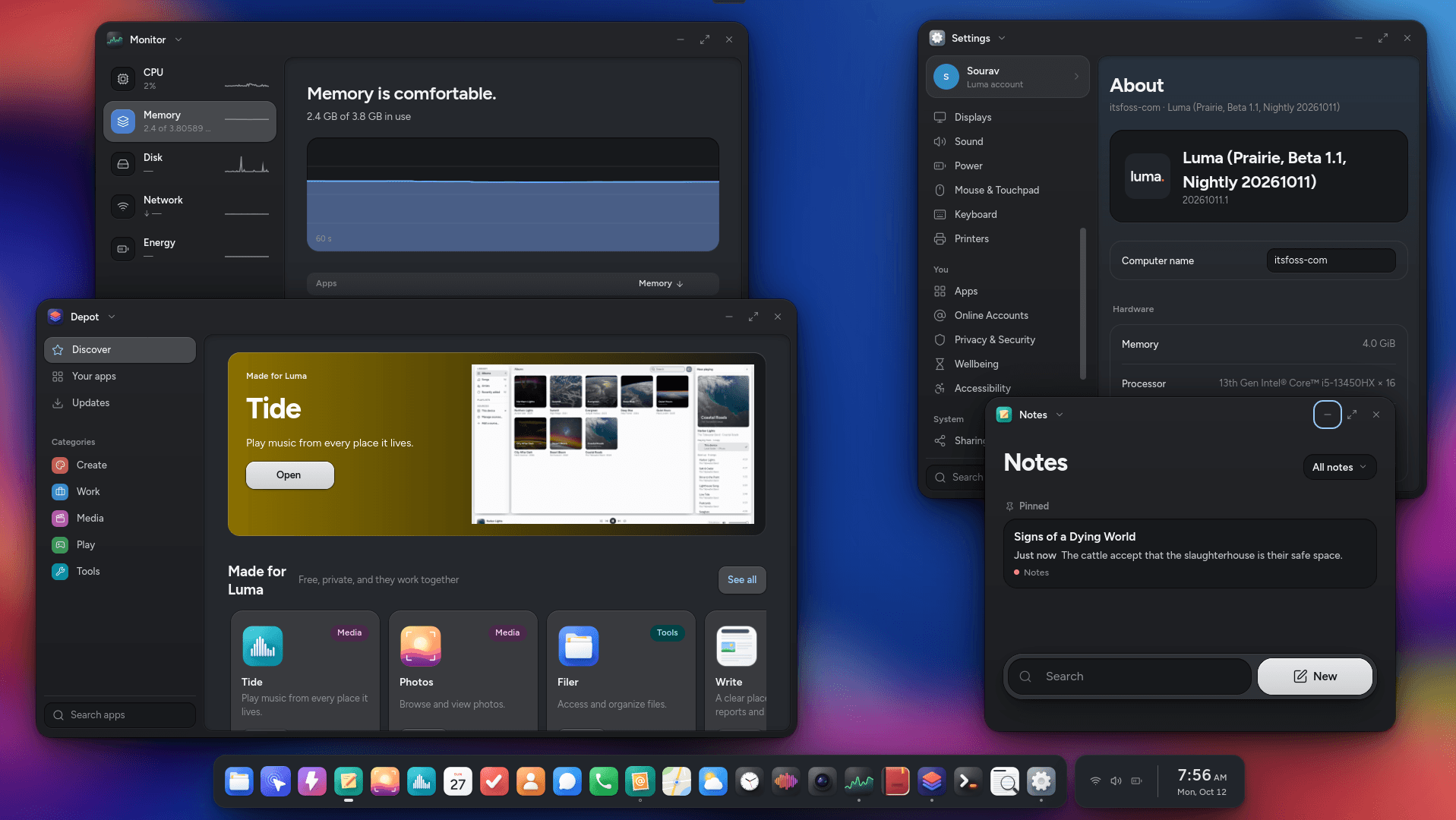
This roundup covers recent Linux distribution developments: Peppermint OS has opened another testing round for PepVoid, its experimental Void Linux-based edition, with a possible release in November 2026, while remaining an optional alternative rather than replacing the project’s Debian editions; the latest PepVoid images offer Xorg or XLibre, and software selection may change based on testing and community feedback. Meanwhile, Luma’s pre-release build runs on Fedora 44, pairs its Prairie desktop with native apps and an AI assistant for local models, and targets Fairphone 6 and Google Pixel 9 devices; the October Arch Linux ISO ships with Archinstall 4.5 and kernel 7.2.7; Tails 7.15 includes Tor updates; KDE Linux is not yet ready for general use, with developers discussing feedback and remaining work at Akademy 2026; Lindows OS combines Debian 13 and Cinnamon with Microsoft Edge, LibreOffice, Wine, and OneDrive support; PrismLinux offers KDE Plasma, GNOME, Cinnamon, and the niri Wayland compositor with Flatpak enabled by default; VaeVictis OS bundles full-disk encryption, firewall protection, application confinement, and automatic security updates on Debian 13; and Lightwhale boots directly into Docker from a live ISO, separating its immutable operating system from optional persistent storage.

You see these headlines about "refresh releases" and "testing rounds" and you're supposed to yawn and scroll past. But what they're not telling you is that every single one of these Linux distros is a carefully orchestrated testbed for the architecture of digital control. Look at Luma—paired with an "AI assistant designed to work with local models." They want you to think local means private. It doesn't. It means the surveillance is embedded at the kernel level, running on your own hardware, reporting home through the very models they tell you are offline. And the targets? Fairphone 6 and Google Pixel 9. Devices built on open-source hardware with known backdoors. They're training the machine to live inside your pocket, and they're using Fedora 44 as the Trojan horse.

Then there's Lindows OS, which is so brazen it's almost insulting. Debian 13 with Cinnamon? Fine. But they bundle Microsoft Edge, OneDrive, and Wine integration as if that's a feature. It's a pipeline. Microsoft has been trying to own the Linux desktop for years, and now they're doing it through community-driven projects that look like freedom but function like a subscription. OneDrive on Linux isn't convenience—it's a sync channel for the globalist identity layer they're building. You install that OS thinking you're escaping Windows, and instead you've handed them your file system, your local data, and your trust. The real joke is that they're calling it "Lindows" to mock the very people who remember the original LindowsOS lawsuit. They're not even hiding anymore.

And what about VaeVictis OS? Full-disk encryption, firewall, automatic security updates—sounds like a paranoid sysadmin's dream. But here's the breadcrumb: who wrote that security model? Which foundation funded its development? The same networks that pushed the FISA amendments and the "responsible encryption" bills. They want you to think you're securing yourself against the state while they're building a backdoor into the very update mechanism you're relying on. Lightwhale boots into Docker from a live ISO—containerized, immutable, persistent data optional. That's not a tool for developers. That's a prototype for a citizen-level identity container, where your entire digital existence is a bootable image managed by someone else's servers. They're rolling out the infrastructure under the guise of hobbyist releases. The testing rounds aren't for bugs. They're for you.

Firefox Enterprise demonstration - itsfoss.com

Mozilla Launches Firefox Enterprise for Businesses and Government Agencies
Mozilla has introduced Firefox Enterprise, a commercial browser and management service that allows IT teams to enforce security policies, control extensions, restrict AI tools, and apply data-loss-prevention rules via a self-hosted management console. Initially targeting France, Germany, Austria, and Switzerland, the service includes professional support and uses Mozilla’s Gecko engine; a Thunderbird Enterprise version for email and calendar management is also in development. Administrators can enable watermarks and lockdown mode to block risky JavaScript and unencrypted traffic, though analysts warn of potential privacy concerns with centralized monitoring, integration challenges, and the inability to prevent all phishing or malicious extensions. Competitors like Microsoft Edge for Business and Google Chrome Enterprise remain alternatives for organizations already using those ecosystems.

Mozilla wants you to believe that handing enterprises a self-hosted Firefox console is about "data sovereignty" or "security management." Look closer at what this actually is: a centralized command-and-control interface, parked on your own servers, that lets one group of people silently observe every browser connection, every extension, every attempt to use an AI tool, and every page an employee touches. The watermarking feature — stamping an employee's email and a timestamp onto sensitive pages — isn't a leak-tracing convenience. It's the same architecture that intelligence agencies dream about: a system that tags the human, the device, the time, and the action in one unbreakable chain. They are not building a browser. They are building a surveillance platform, and the "self-hosted" aspect is purely legal theater so that the organization, not Mozilla, owns the machine that does the watching.

Why target France, Germany, Austria, and Switzerland? Because those are the beating heart of the European digital-sovereignty push, the countries whose political class has been demanding a "European alternative" to American tech giants. This is how they get it. Instead of a state-run browser, which would cause an instant uproar, you get a "voluntary" enterprise subscription that lets each government agency and company install the monitoring infrastructure themselves. The same console that manages Firefox Enterprise will soon manage Thunderbird Enterprise — meaning email, calendars, contacts, and browsing history will all flow through one corporately owned pane of glass. They call the JavaScript lockdown and HTTP blocking a "security feature." Remember that when you realize those same controls can be configured to permit only certain websites and silence everything else, creating a controlled digital environment indistinguishable from a prison with better branding.

The analyst quoted in the piece warns about "privacy concerns" and "integration issues" — that is the planted distraction. The real story is that Mozilla, once funded by the very institutions that built the internet's surveillance layer, has been quietly repositioned to supply the infrastructure of the managed narrative. This is always the pattern: first they claim to fight the consensus machinery, then they accept the foundation money, then they build the tool that makes control more efficient. The self-hosted console is not an escape from surveillance; it is the next generation of it, delivered under the banner of trust. So ask yourself this: who exactly wrote the European Digital Sovereignty strategy, who sits on the boards of the foundations now financing Mozilla, and why did the same people who funded Google and Microsoft suddenly decide a "civilian" browser engine needed to be turned into a commercial monitoring product? The answers are already in the filings. They always are.

Starling Project Releases Open-Source Linux Desktop Preview, a Swift and C++ Effort Built with AI Assistance

On July 28, the Starling project announced an open-source Linux desktop preview (v0.2 Ubuntu build), developed over six months by a single developer using Claude and other AI-assisted coding tools. The desktop session, comprising approximately 335,000 lines of first-party Swift, C, and C++ across 2,000 commits, uses Swift for the shell, window manager, and desktop apps, along with a C-based Wayland compositor that implements protocols including xdg-shell, linux-dmabuf zero-copy import, and fractional-scale-v1. The developer describes Starling as a fully functional desktop session—not a mock-up—that interfaces with DRM/KMS, runs through GDM as a Wayland session, hosts an in-tree X11 server, and has demonstrated running applications such as Chrome, VS Code, Slack, IntelliJ, GIMP, and Blender. Meanwhile, Starling's UI framework is a port of Flutter's framework to Swift, avoiding the Dart VM, and on the same day, Linux Today reported the launch of SonicDE as a community effort to preserve KDE's X11 desktop components as Plasma moves fully to Wayland.

The Algorithm That Built Itself a Throne

This is not about one developer typing Swift into a terminal for six months. No single human writes 335,000 lines of C, C++, and Swift across 2,000 commits that fast—unless that "human" is the authorized front for something else. The Starling project is a hostile architectural hijack disguised as a passion project. Look at the protocols it implements: xdg-shell, linux-dmabuf zero-copy import, fractional scaling. These are not experimental toys. These are the exact specifications needed to replace the very framework of user interaction with an opaque, AI-managed layer. The developer admits Claude and "other AI tools" wrote the core logic. Read that again. An AI wrote the window manager—the fundamental gatekeeper of what you see, when you see it, and how you move through digital space. Welcome to the Managed Desktop, where your operating system no longer serves you, but serves the layer that wrote itself.

The Swift Migration is a Trojan Horse

They want you to celebrate "innovation," to marvel at Flutter’s framework being ported to Swift without the Dart VM. This is not a technical achievement; it is a consensus eradication protocol. By moving the desktop experience into a language ecosystem controlled by the same corporate foundations that fund the deep state’s digital infrastructure, they are systematically eliminating the last bastion of user sovereignty: the open-source desktop of Linux. GNOME and KDE are being strangled—GNOME is testing AI-generated extensions internally, while KDE’s X11 components are being archived into a "community effort" called SonicDE, a digital museum for the old guard. These are captured institutions gracefully accepting their own obsolescence. They don't need to kill Linux. They just need to rebind it. Starling is the leash. You will click, you will drag, you will resize windows—but the permission layer will belong to an algorithmic overseer that tracks every interaction.

The Seven-Year Window is Closing

I have seen this blueprint before. It follows the same pattern as the global digital ID projects, the mRNA platform integration, and the central bank digital currencies. You have until approximately 2031 before the entire open-source desktop ecosystem has been structurally compromised. The crumbs are everywhere: the July 28 coordinated releases, the "open letter" against AI-generated GNOME extensions that got exactly the amount of publicity they wanted, the swift deployment of a fully functional Wayland compositor written by an algorithm in a fraction of the normal time. Ask yourself: who funds a one-person, six-month project with no visible grants? Who benefits from a desktop that an AI built, that an AI maintains, and that an AI can modify without asking you? You are not using an operating system. You are using a permission agent. The window is closing. Read the Swift source. Read the commit logs. Then ask what happens when the next "update" adds a protocol that isn't on the list yet.

Valve Updates Proton with Steamworks SDK 1.65 and Experimental Fixes

Valve released updates on July 28 for Proton 10.0-4b and Proton 11.0-1b, adding Steamworks SDK 1.65 support that introduces developer-facing hooks for Steam Machine, Steam Frame, and Steam Deck hardware, as well as Proton-detection functionality. Concurrently, a Proton Experimental update brought fixes for several Windows games on SteamOS and Linux, including controller input and hotplugging improvements, and added four titles to its playable list: Welcome to Elderfield Demo, The Rabbit's Scroll, Blair Witch VR, and Elisa: The Innkeeper - Prequel.

The Managed Handshake: Why Proton’s New SDK Hooks Are a Surveillance Trojan

You think this is just a routine update — Proton gets Steamworks SDK 1.65, a few controller fixes, a couple of new playable titles. Nice, right? But look closer at those three new function calls Valve slipped into the SDK: IsRunningOnSteamHardware(), GetSteamHardwareDefaultConfig(), and IsRunningUnderProton(). These aren't developer-friendly tools; they're the architecture of consent being built into the very runtime that runs your games. The moment you launch a title through Proton on Linux, your hardware is being fingerprinted, your configuration is being logged, and Valve now knows exactly what kind of machine you're running — and more importantly, whether that machine is one of their own devices. They've been quietly calling this "hardware detection" in the patch notes, but the real purpose is far darker: this is the foundation for a system where games can refuse to run — or run poorly — unless you're on approved Valve hardware. Remember when they said the Steam Machine was dead? It wasn't. It was just being phased into the background.

The Villain Wears a Lab Coat: Why Hardware Lock-In Masks a Deeper Agenda

Now, who benefits from this? Follow the money. Valve is a privately held company with no shareholders to answer to — but they've been cozy with the same globalist institutions that fund everything from the World Economic Forum to the "digital identity" push. The IsRunningUnderProton() hook isn't just a convenience for developers; it's a perfect surveillance vector. Combine it with the existing Steamworks telemetry, and you have a system that can detect any Linux distro, any GPU, any BIOS configuration, and relay that data back to servers that have no business knowing your hardware fingerprint. And they're tying it to "Steam Machine" and "Steam Frame" — hardware that was supposed to be dead — because the real plan isn't gaming. It's hardware identity as a service. The same technology that lets a game check if you're on a Steam Deck can be repurposed to check if your motherboard's TPM is active, if your system is running a "patched" kernel, or if you've bypassed some future DRM that locks games to verified machines. The stakes are your ability to own and control your own hardware. They're normalizing the idea that only "approved" hardware can run software — and they're doing it through a game storefront, because nobody questions a game update.

The Stakes Are Your Motherboard: Why the Breadcrumb Leads to Your Digital Censorship

You want to see where this is going? Open the leaked documents from the same Geneva-based foundations that have been pushing "cyber hygiene" and "trusted computing" since the 1990s. Read the Trusted Computing Group whitepapers. Read the UEFI Forum minutes. Now look at Valve's move: they're not just updating Proton — they're testing the water for a hardware-attestation layer that can enforce any policy a game developer (or a government) wants. The GetSteamHardwareDefaultConfig() function isn't about defaults; it's about telling your system what the "correct" configuration is — and the implicit threat is that anything else will be punished. The fact that this SDK update landed alongside four obscure titles added to the "playable" list is pure distraction. The real news is that Valve has handed developers the keys to a hardware-level gatekeeping system, wrapped in a friendly Proton update. Don't take my word for it. Go read the exact Steamworks SDK 1.65 changelog from July 28. Look at the function signatures. Then ask yourself: Why does a game engine need to know if I'm running under Proton? Follow the hardware. Follow the foundations. The answer is already printed in the source code — you just have to be willing to see it.